

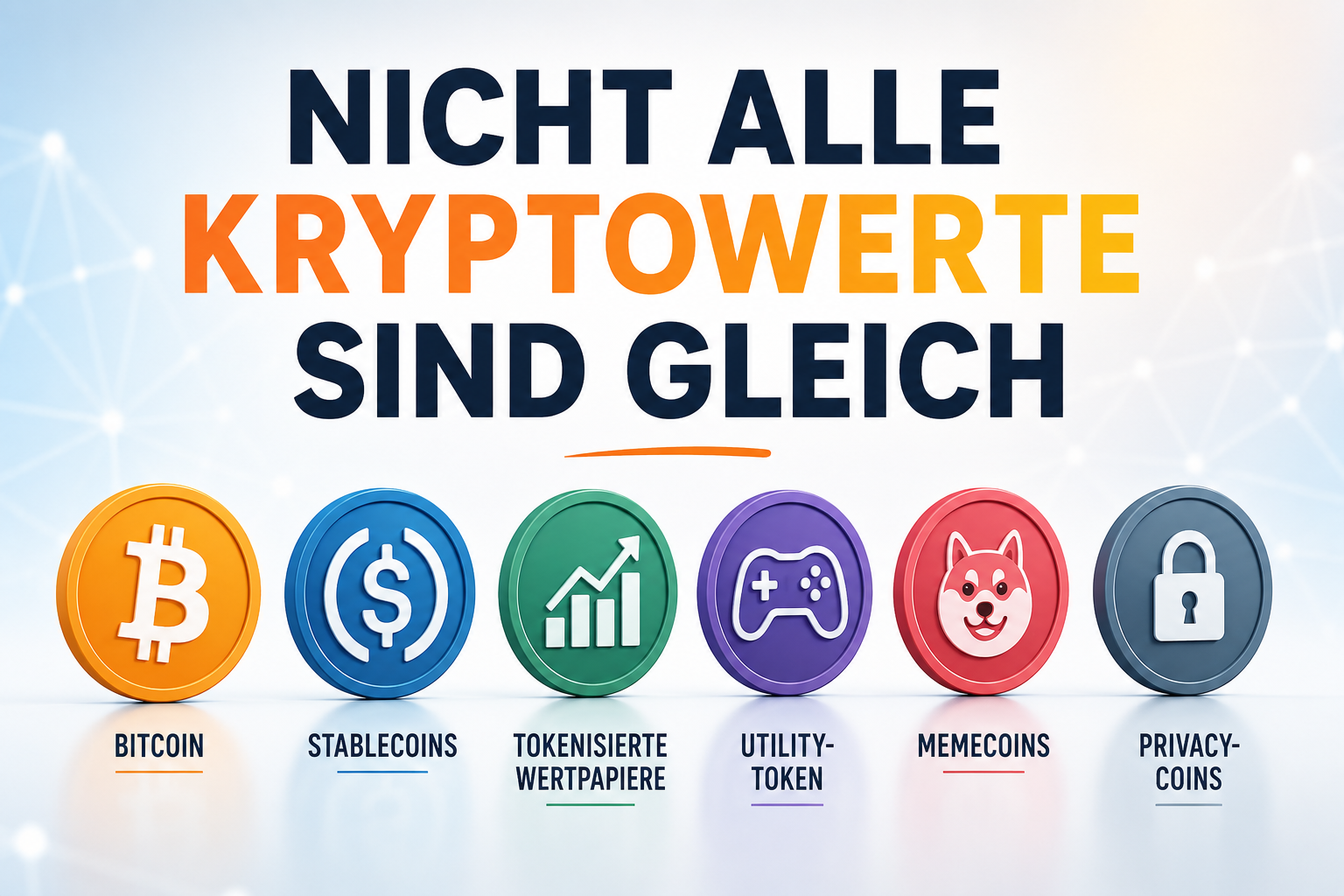
Not all cryptocurrencies are the same
Why flat-rate crypto taxes miss the heart of the problem
In political discourse, the term “cryptocurrencies” is often used as if it were a single, uniform asset class. This often leads to calls for all cryptocurrencies to be taxed differently in the future than they have been in the past.
But that’s exactly where the problem begins.
Today, the term “cryptocurrencies” encompasses thousands of very different projects, technologies, and use cases. Bitcoin, stablecoins, tokenized stocks, utility tokens, memecoins, and even future central bank digital currencies are often lumped together, even though they serve completely different economic functions.
Anyone discussing the tax treatment of cryptocurrencies should therefore first answer the following question:
Which cryptocurrencies, exactly?
Not all Bitcoin is the same
Even within the crypto market, individual projects differ significantly.
Bitcoin, for example, has:
- no publisher
- no central organization
- no dividends
- no claim against third parties
- no corporate structure
From an economic perspective, Bitcoin is therefore more akin to a digital commodity or a digital asset than to a stock or a traditional financial product.
It is not without reason that Bitcoin is often referred to as “digital gold.”
Other cryptocurrencies, on the other hand, work completely differently.
Stablecoins behave like digital currencies
Stablecoins such as USDT or USDC have a completely different purpose.
They are designed to reflect the value of traditional currencies such as the U.S. dollar or the euro as accurately as possible and are primarily used as a means of payment or a unit of account.
Economically, they are therefore more similar to:
- Foreign currencies
- Electronic money
- digital payment systems
rather than an asset like Bitcoin.
Tokenized shares remain shares in economic terms
As financial markets become increasingly digitized, more and more tokenized securities are emerging.
Technically speaking, these are blockchain tokens, but from an economic perspective, they are often:
- Stocks
- Bonds
- mutual fund shares
- Bonds
In these cases, the blockchain serves merely as a technical infrastructure.
Its economic function remains that of a traditional security.
Utility tokens, memecoins, and digital memberships
In addition, there are other categories:
Utility token
They provide access to digital services or platforms and are often similar to digital vouchers or usage rights.
Meme coins
They are often based on internet culture, community effects, and speculation. Their economic function differs fundamentally from that of Bitcoin or stablecoins.
Privacy Coins
Projects like Monero and Zcash focus on protecting transaction privacy and, as a result, serve a different purpose than most other cryptocurrencies.
The digital euro makes it even harder to draw a line
In the coming years, the digital euro could add another category to the mix.
This is not a private cryptocurrency, but digital central bank money issued by the European Central Bank.
The digital euro would be:
- legal tender
- a claim against the central bank
- functionally comparable to cash
This example also illustrates just how varied digital assets can be.
The more digital financial instruments emerge, the more difficult it becomes to categorize all cryptocurrencies in a uniform manner.
Politicians are facing a classification problem
The real challenge isn’t coming up with a new tax.
The challenge lies in finding a meaningful way to classify the various cryptocurrencies.
Should Bitcoin be treated the same as gold for tax purposes?
Should a stablecoin be treated like a foreign currency?
Should a tokenized share be treated differently from a traditional share?
Should a utility token be treated like a voucher?
And how will we handle new categories that don’t even exist yet?
The closer you look, the harder it is to find a one-size-fits-all solution.
The current system already solves this problem
The current tax treatment of cryptocurrencies is part of the existing framework of German tax law.
Cryptocurrencies are generally treated in the same way as other assets, to which the provisions of Section 23 of the German Income Tax Act (EStG) also apply.
This includes, for example:
- Gold
- Precious metals
- Foreign currencies
- Works of art
- Classic car
- Collectibles
The standard one-year holding period applies to these assets.
This arrangement has proven to be workable over many years and provides a legally sound framework for a wide variety of assets.
A special provision would create new problems
Anyone wishing to tax cryptocurrencies differently in the future would first have to provide a convincing justification for why these assets, of all things, should be treated differently from gold, foreign currencies, or other economic assets.
At the same time, this would raise numerous new questions:
- Which cryptocurrencies are subject to the special rule?
- Who decides on the assignment?
- What happens if technical changes are made to a project?
- How are new token categories handled?
Rather than solving existing problems, a blanket special tax would create additional uncertainty.
Why the status quo is compelling
The sheer diversity of cryptocurrencies is a strong argument for maintaining the existing tax framework.
The current regulation:
- treats crypto assets consistently with other assets
- avoids complicated issues of demarcation
- ensures legal certainty
- reduces bureaucracy
- and provides a practical tax treatment for a wide variety of digital assets
Anyone wishing to change this well-established system must not only explain the economic consequences but also outline how the numerous new issues regarding classification and demarcation are to be resolved in the future.
So far, there have been no convincing answers to these questions.
Conclusion
The political debate about “cryptocurrencies” often falls short.
Bitcoin is not the same as a stablecoin. A stablecoin is not the same as a tokenized stock. And a tokenized stock is not the same as a memecoin.
The diversity of cryptocurrencies is precisely the strongest argument for maintaining the current tax system.
The one-year holding period has proven to be a workable solution. It places crypto assets within an existing legal framework, avoids new definitional issues, and treats digital assets in the same way as other economic assets such as gold, foreign currencies, art, or classic cars.
Anyone who wants to change the status quo should first be able to explain how the various cryptocurrencies should be classified in the future. Until then, there are good reasons to stick with the tried-and-true approach.