
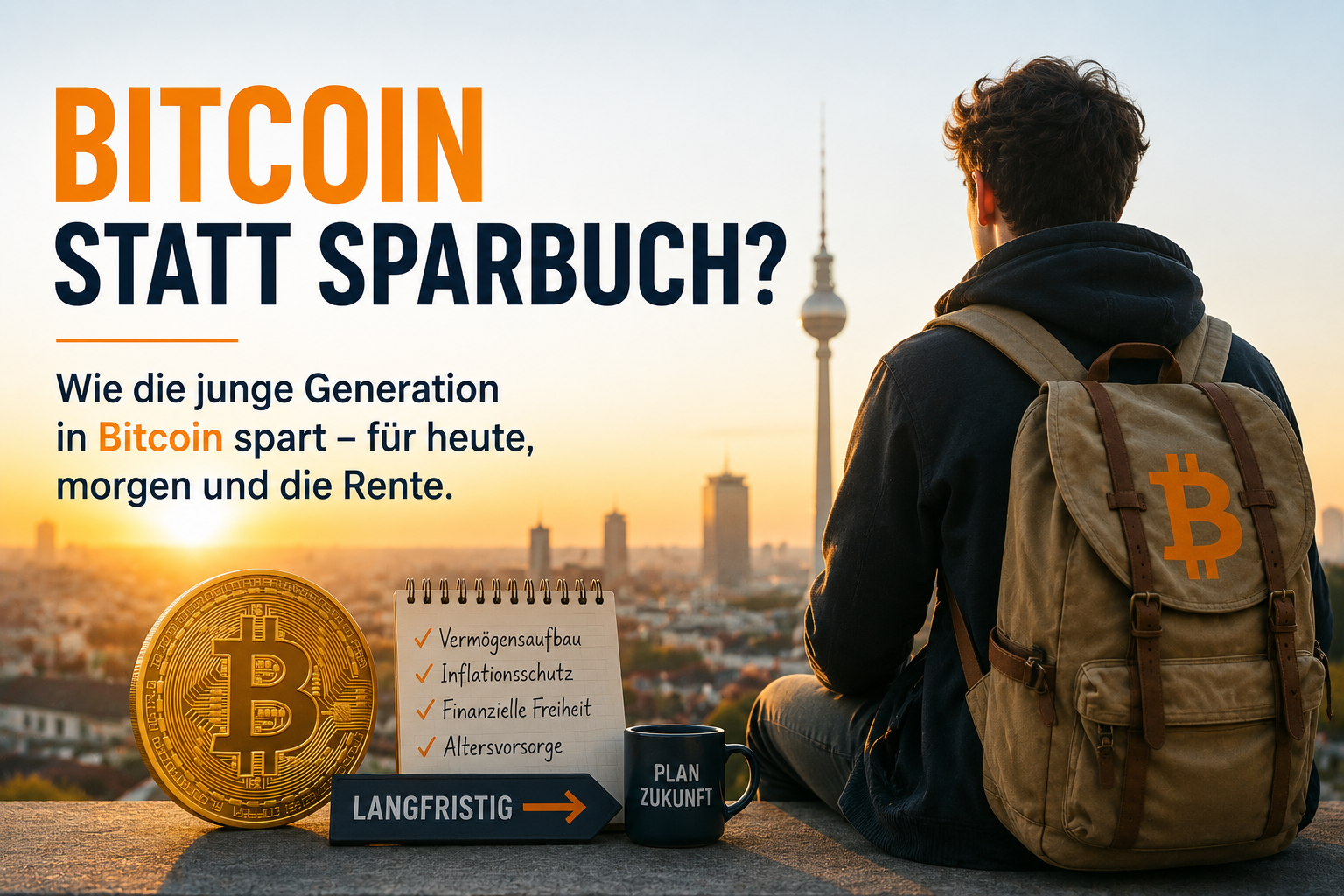
Bitcoin Instead of a Savings Account?
How Germany’s Younger Generation Is Changing the Investment Culture
For a long time, Germany was considered a nation of savers. For decades, checking accounts, money market accounts, and savings accounts were the preferred ways to build wealth and achieve financial security.
But a look at the younger generation shows that German investment culture is changing.
A recent study by the brokerage firm eToro has reached a remarkable conclusion: More than half of German Gen Z investors already hold cryptocurrencies. This means that digital assets are even more widespread among this age group than German or international stocks.
This development raises an interesting question:
Is this a new generation of speculators—or are we witnessing the emergence of a new culture of saving and investing?
The Bitcoin Generation
According to the eToro study, in the first quarter of 2026, about 52 percent of German investors between the ages of 18 and 27 held cryptocurrencies.
At the same time, many of the respondents said they wanted to further expand their positions.
Anyone following the public debate might quickly conclude that young people are increasingly turning to short-term speculation.
But the study paints a different picture.
The majority of young investors do not invest exclusively in cryptocurrencies. Rather, their broadly diversified portfolios consist of:
- Stocks
- ETFs
- Raw Materials
- Bonds
- and digital assets
Cryptocurrencies are not viewed as a substitute for traditional investments, but rather as an additional asset class within a long-term wealth-building strategy.
From Gambling to Saving
It is particularly interesting to note that perceptions of cryptocurrencies are changing.
While Bitcoin’s early years were often marked by speculation, trading, and short-term price fluctuations, many young investors today increasingly view Bitcoin as a long-term asset.
This is especially true for Bitcoin.
This is because Bitcoin differs from many other cryptocurrencies due to its distinct characteristics:
- a limited quantity of 21 million units
- no central oversight body
- tradable worldwide
- Can be stored on your own at any time
- independent of banks and governments
As a result, many young people are viewing Bitcoin less as a speculative asset and increasingly as a digital savings tool.
The question is no longer:
“How can I get rich quick?”
Rather:
“How can I safeguard my purchasing power in the long term and build wealth?”
Retirement Planning for the Digital Generation?
Young people, in particular, face special challenges today.
Traditional retirement planning is coming under increasing pressure:
- rising life expectancy
- demographic change
- Inflation
- Falling real returns on many savings products
At the same time, many young people have a high level of digital literacy and easy access to financial information.
While earlier generations often built their wealth through savings accounts or endowment life insurance policies, many young investors today are looking for alternatives.
Bitcoin is increasingly being viewed as a long-term building block for wealth accumulation.
Quite a few investors follow what is known as a savings plan approach:
Instead of speculating on short-term price movements, they regularly buy small amounts of Bitcoin and hold onto them for many years.
This strategy is more like an ETF savings plan than traditional trading.
The holding period encourages long-term thinking
Interestingly, the German tax system is well-suited to this long-term approach.
Under current law, gains from Bitcoin and other cryptocurrencies are tax-free after a one-year holding period.
This policy provides a clear incentive for long-term saving and investing.
People who hold Bitcoin for an extended period of time are treated differently for tax purposes than those who speculate in the short term.
It is precisely this distinction that reflects the original intent of Section 23 of the Income Tax Act (EStG): Short-term speculation can be taxed, whereas long-term wealth accumulation cannot.
The current debate over the possible elimination of the holding period would therefore affect precisely those investors who view Bitcoin not as a speculative asset but as a long-term investment.
Germany Will Not Become a Country of Gamblers
Another finding of the study deserves special attention.
Nearly three-quarters of German retail investors describe their risk tolerance as moderate or high. At the same time, they are increasingly investing in a diversified manner and for the long term.
That doesn’t mean Germany will suddenly become a country of speculators.
Rather, the way risk is perceived is changing.
Previous generations asked:
How can I avoid risk?
Many young investors today ask:
Which risks are worth taking—and how can I manage them effectively?
Bitcoin is increasingly seen as just one building block among many.
Wealth Building Goes Digital
The figures show one thing above all else:
Germany is undergoing a gradual shift in its investment culture.
Young people are increasingly taking charge of their own investments, doing their own research, and using digital tools to build their wealth.
Bitcoin plays an important role in this.
Not because every young investor is hoping to get rich quick.
Rather, it is because Bitcoin has become a long-term savings and investment vehicle for many people.
Conclusion
The latest eToro study debunks a widespread stereotype.
Young Bitcoin investors are not necessarily speculators.
In fact, there are many indications that Bitcoin is increasingly being viewed as a long-term asset and a building block for personal wealth accumulation.
For many members of Generation Z, Bitcoin is no longer just a short-lived fad.
It is part of a new investment culture—digital, self-directed, and focused on the long term.
Anyone who views the debate over Bitcoin solely through the lens of speculation and risk could therefore overlook a decisive social transformation.