
The Federal Ministry of Finance Plans a Change in the Bitcoin Taxation System:
Why the holding period Must Be Maintained
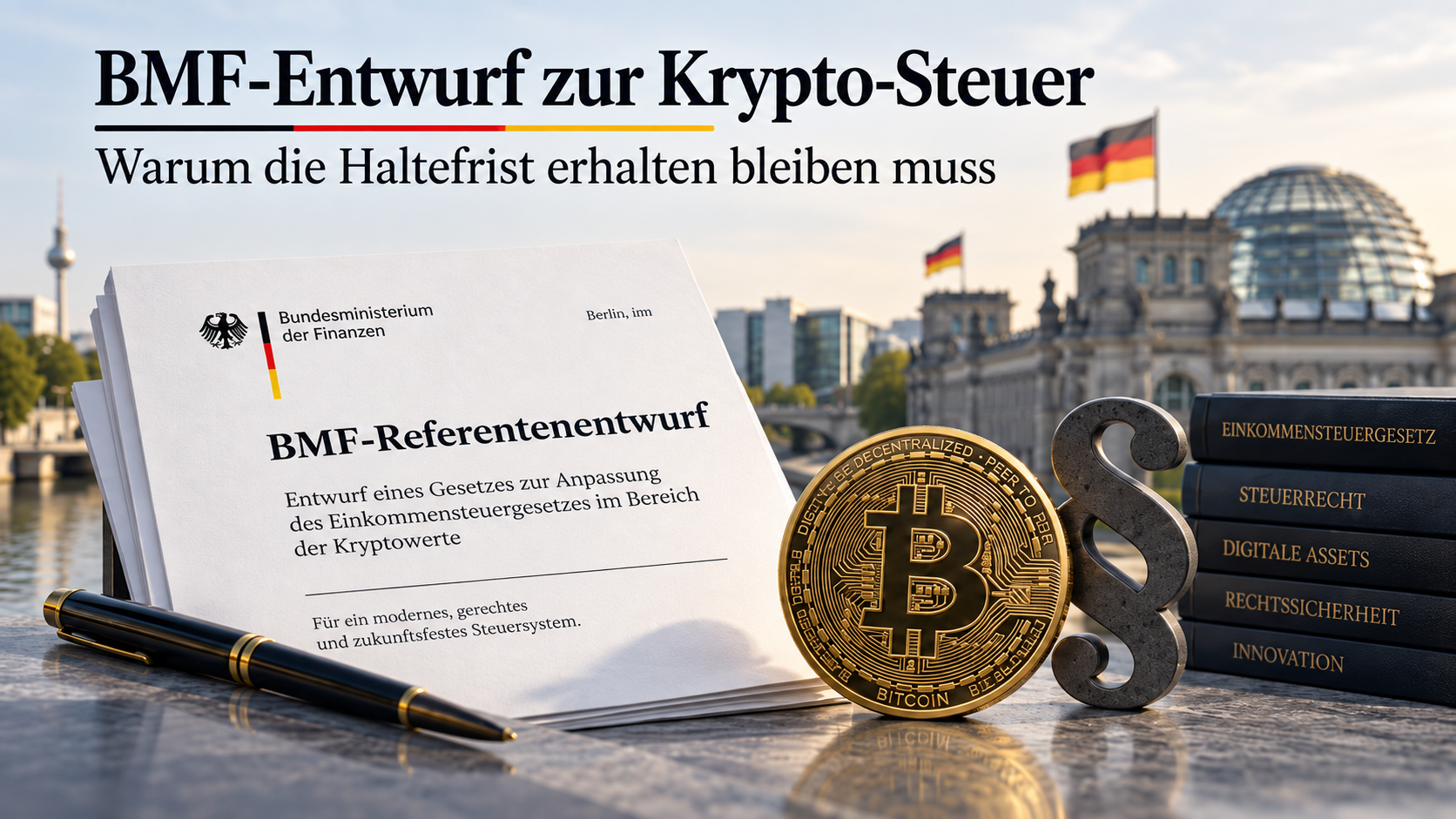
The draft bill from the Federal Ministry of Finance, which has now been made public, calls for a fundamental overhaul of the taxation of Bitcoin and other cryptocurrencies. In the future, gains are to be taxed at a flat rate of 25 percent, regardless of the holding period. The German Bitcoin Association opposes the elimination of the one-year holding period. In our view, the draft does not resolve key problems—and creates new ones elsewhere.
Statement by the German Bitcoin Association on the recently released draft bill by the Federal Ministry of Finance regarding the taxation of cryptocurrencies – as of September 15, 2026
Over the past few months, there has been much discussion about whether the one-year tax holding period for Bitcoin and other cryptocurrencies should be abolished. Now, the Federal Ministry of Finance’s plans are taking shape.
According to consistent media reports, a draft bill from the Federal Ministry of Finance (BMF) proposes that so-called exchange-based cryptocurrencies such as Bitcoin no longer be treated as private sales transactions under Section 23 of the Income Tax Act (EStG), but rather as income from capital assets under Section 20 of the Income Tax Act (EStG). Capital gains would thus be taxable regardless of the holding period and would generally be subject to the 25 percent flat-rate withholding tax, plus the solidarity surcharge and, if applicable, church tax.
The draft has not yet been officially published and is not yet law. Details may therefore change as the process continues. However, the general direction that has now become known is clear enough to allow for a political and technical assessment.
It’s not just about 25 percent—it’s about a systemic change
In public discourse, the reform is often reduced to a seemingly simple statement: Bitcoin gains will be taxed at 25 percent in the future.
That doesn’t go far enough.
In fact, the proposal would fundamentally change the tax treatment of Bitcoin. Currently, privately held Bitcoin is generally classified as “other assets.” If held for more than one year, any subsequent capital gain on a private sale is generally no longer subject to § 23 of the German Income Tax Act (EStG).
It is precisely this system that is to be abandoned for Bitcoin acquired in the future.
As a result, an asset whose tax treatment has thus far depended, among other things, on the holding period and specific use would become, for tax purposes, a form of investment property.
From the perspective of the German Bitcoin Association, this step is not sufficiently justified.
Bitcoin is neither a stock nor a bond. There is no issuer, no debtor, no dividend, and no contractual right to a cash flow. Bitcoin can be held as a long-term asset, but it can also be used as a means of payment and as an open monetary and technical infrastructure.
It is noteworthy that the Federal Ministry of Finance, in its previous letter regarding the treatment of cryptocurrencies under income tax law, also explicitly states that the tax assessment must be based on the specific function of each cryptocurrency.
The legislature should maintain precisely this functional approach.
The proposal creates exactly the wrong incentive
The proposed reform also leads to a result that is inconsistent from a tax policy perspective.
Under current law, short-term gains on Bitcoin realized within the one-year holding period are taxed at the individual income tax rate. This rate can be significantly higher than 25 percent.
On the other hand, anyone who saves for the long term and holds their Bitcoin for more than a year can, in principle, realize a capital gain from a private sale tax-free under current law.
The new draft would reverse this ratio.
Long-term investors would be subject to permanent taxation for the first time. A short-term trader with a high personal income tax rate, on the other hand, might even benefit from the flat tax rate of 25 percent.
A reform that is explicitly justified on the grounds of greater tax fairness should be able to explain why short-term speculation is to be given tax relief while long-term savings are to be permanently taxed for the first time.
From the perspective of the German Bitcoin Association, this creates the wrong incentive.
Grandfathering is the right approach—but it doesn’t solve the underlying problem
On the positive side, the draft that has come to light apparently provides for grandfathering provisions.
According to reports so far, the new tax rules will apply only to crypto assets acquired after December 31, 2026. For existing holdings, however, the current law—including the one-year holding period—will continue to apply.
This represents a significant step forward compared to models discussed in the past and takes into account the trust of those who made their investment decisions based on the existing legal framework.
However, grandfathering does not solve the fundamental problem.
Rather, two tax systems would coexist permanently in the future: existing holdings with a holding period and new holdings without a holding period. This creates a significant additional burden in terms of documentation and allocation, particularly for Bitcoin, which can be transferred between exchanges, brokers, and personal wallets and managed in the form of individual UTXOs.
What appears to be a simpler tax system could, in practice, turn out to be more complicated.
Bitcoin is also a means of payment—and this is precisely where the reform becomes problematic
One particularly important point has been largely overlooked in the political discussion so far: Bitcoin is not just an investment asset.
Bitcoin can be used to make payments. Through the Lightning Network, payments can be processed in seconds at very low cost. This also enables micropayments, which are hardly economically viable with traditional payment systems.
For tax purposes, a payment made in Bitcoin also constitutes a sale.
Today, this issue is limited by the holding period. If Bitcoin is used after one year has elapsed, the capital gain realized in the transaction is generally no longer subject to taxation under § 23 of the German Income Tax Act (EStG).
If the holding period is eliminated, however, the use of Bitcoin held for years to purchase goods or services may still have long-term tax implications.
For each payment transaction, it would generally be necessary to determine which bitcoins were used, at what price they were originally purchased, what their value in euros was at the time of payment, and what taxable profit resulted from the transaction.
When buying a car, such a calculation might still seem reasonable. But when it comes to coffee, digital content, Lightning payments, streaming payments, or automated payments between machines and AI systems, it is not.
Germany would thus impose tax hurdles on precisely those applications in which Bitcoin enables technological innovation beyond mere capital investment.
For this reason, the Bitcoin Federal Association is calling for a clear de minimis rule for small and micro payments by private individuals, regardless of the general holding period.
An automatic tax withholding doesn’t necessarily go hand in hand with self-custody
The practical problems will become even greater with the automatic tax withholding by crypto service providers, which is scheduled to begin in 2028.
With a traditional securities account, the purchase, custody, and sale are often handled by the same bank. The bank knows the date of acquisition and the acquisition cost and can use this information to determine the tax basis.
Bitcoin works differently.
A user can buy Bitcoin from a regulated provider, then transfer it to their own hardware wallet, use part of it via the Lightning Network years later, and deposit another portion with a completely different provider.
This option for self-custody is not an exception or a flaw in the system. It is one of Bitcoin’s fundamental characteristics.
A service provider who receives Bitcoin at a later date therefore does not automatically know its tax history.
We therefore view reports—according to which the draft is said to provide for a flat-rate substitute tax base in the absence of purchase data—with particular skepticism. This can lead to significant discrepancies from the actual gains realized, particularly in the case of Bitcoin held for the long term or transferred between one’s own wallets.
The German Bitcoin Association has already pointed this out in its position paper: A mandatory tax withholding should not be introduced until purchase data can be reliably recorded, standardized, and transferred between providers.
Self-custody must not result in a tax disadvantage.
And private keys or seed phrases must never be requested as proof for tax purposes.
New transparency rules are already in effect—their impact should be evaluated first
The German federal government repeatedly cites tax enforcement issues as a reason for reforms in the cryptocurrency sector.
Effective and consistent tax enforcement is legitimate and is expressly supported by the Bitcoin Federal Association.
But this is precisely where the data is already undergoing a fundamental shift.
With DAC8, the Crypto Asset Tax Transparency Act, and the International Crypto-Asset Reporting Framework, comprehensive reporting and exchange obligations are being introduced for crypto service providers. As a result, tax authorities will receive significantly more information about crypto transactions in the future than they have in the past.
These instruments have only just been created.
Before lawmakers make fundamental changes to the substantive taxation of Bitcoin in parallel, they should first examine what impact these new transparency tools actually have.
Our guiding principle therefore remains:
Evidence over structural reform.
Also noteworthy in this context is the scale of the revenue projections now being reported. While the political debate at times mentioned potential amounts in the billions, according to current reports, the Federal Ministry of Finance (BMF) is initially projecting approximately 160 million euros in additional revenue in 2028 for the draft now on the table, rising to approximately 350 million euros annually.
This, too, is a reason to carefully weigh the costs, bureaucracy, location effects, and actual additional tax revenue against one another.
The public and the industry have sent a clear message
Opposition to the elimination of the holding period has now spread far beyond individual companies or associations.
The Bitcoin Federal Association is one of the co-initiators of the ProHaltefrist initiative. Several members of our association are among the petitioners who submitted a petition to the German Bundestag calling for the retention of the tax holding period.
Within just about 24 hours of being posted, the petition reached the required 30,000 signatures, thereby meeting the threshold for a public hearing in the Petitions Committee.
At the same time, ProHaltefrist is supported by a broad alliance from the German Bitcoin and crypto industry. Nearly 200 companies, exchanges, brokers, associations, media outlets, communities, and other supporters have joined the initiative. Among them are numerous leading companies in the German and European Bitcoin ecosystem.
Politicians should take this signal seriously.
This is not about fundamentally questioning the need for taxation. It is about creating a tax system that works from a technological standpoint, does not disadvantage long-term wealth accumulation compared to short-term speculation, and keeps Germany competitive as a location for Bitcoin companies and digital financial innovations.
What the German Bitcoin Association Is Now Calling For
The German Bitcoin Association will advocate for this during the remainder of the legislative process,
- to maintain the one-year holding period for Bitcoin held directly as part of personal assets,
- Taxing cryptocurrencies based on their economic function rather than applying a blanket tax based on a technical umbrella term,
- to introduce a workable de minimis rule for private Bitcoin and Lightning payments,
- To treat self-custody and transfers between one’s own wallets as tax-neutral and practical,
- to first enable standardized and portable acquisition data prior to a mandatory tax withholding,
- to initially evaluate the impact of DAC8 and the Crypto Asset Tax Transparency Act using real-world data,
- and to conduct a comprehensive consultation with the affected companies, associations, and technical experts before making any fundamental changes.
Our conclusion: The holding period is not a problem that needs to be eliminated
With the proposed grandfathering provision, this draft certainly represents an improvement over models discussed in the past. It also shows that the Federal Ministry of Finance has, at least in part, recognized the practical difficulties involved in a reform.
However, that does nothing to change the underlying problem.
The reclassification of Bitcoin from Section 23 of the Income Tax Act (EStG) to capital gains under Section 20 of the Income Tax Act (EStG) would represent a profound change to the system. It would permanently tax long-term savings, partially reduce the tax burden on short-term speculation, make Bitcoin payments more difficult, and create new challenges regarding self-custody and tax withholding.
Germany should not be too quick to abandon a system that works and has been upheld by the highest courts, especially when new tools to improve tax enforcement are just now being introduced.
The Bitcoin Federal Association’s position therefore remains clear: The one-year holding period should be maintained.
Tax law must be enforceable, technology-neutral, and economically sound. It should enable innovation and provide legal certainty—not create new problems through blanket generalizations.
Germany has the opportunity to establish a reliable regulatory framework for Bitcoin and digital financial innovations.
We should take advantage of this opportunity.
Further information
Position Paper by the German Bitcoin Association:
https://bitcoin-bundesverband.de/wp-content/uploads/2026/08/Bitcoin_Bundesverband_Positionspapier_Bitcoin-Besteuerung_2026-08-17-1.pdf
Summary of the position paper:
https://bitcoin-bundesverband.de/bitcoin-steuer-deutschland-haltefrist-positionspapier/
ProHaltefrist Initiative:
https://prohaltefrist.de/
Note on the Status of the Proceedings: The draft bill from the Federal Ministry of Finance discussed in this article had not yet been officially published at the time of publication. The description of the proposed new regulations is based on consistent media reports regarding the draft. The Bitcoin Federal Association will update its assessment as soon as an official draft is published.