

Bitcoin Tax: Bundestag Hearing Highlights Contradictions in the Proposed Reform
A petition with over 44,400 supporters warns against misguided tax incentives, additional bureaucracy, and minimal additional revenue. The holding period for gold, art, and classic cars is also being discussed. The Federal Cabinet is scheduled to address the reform on Wednesday.
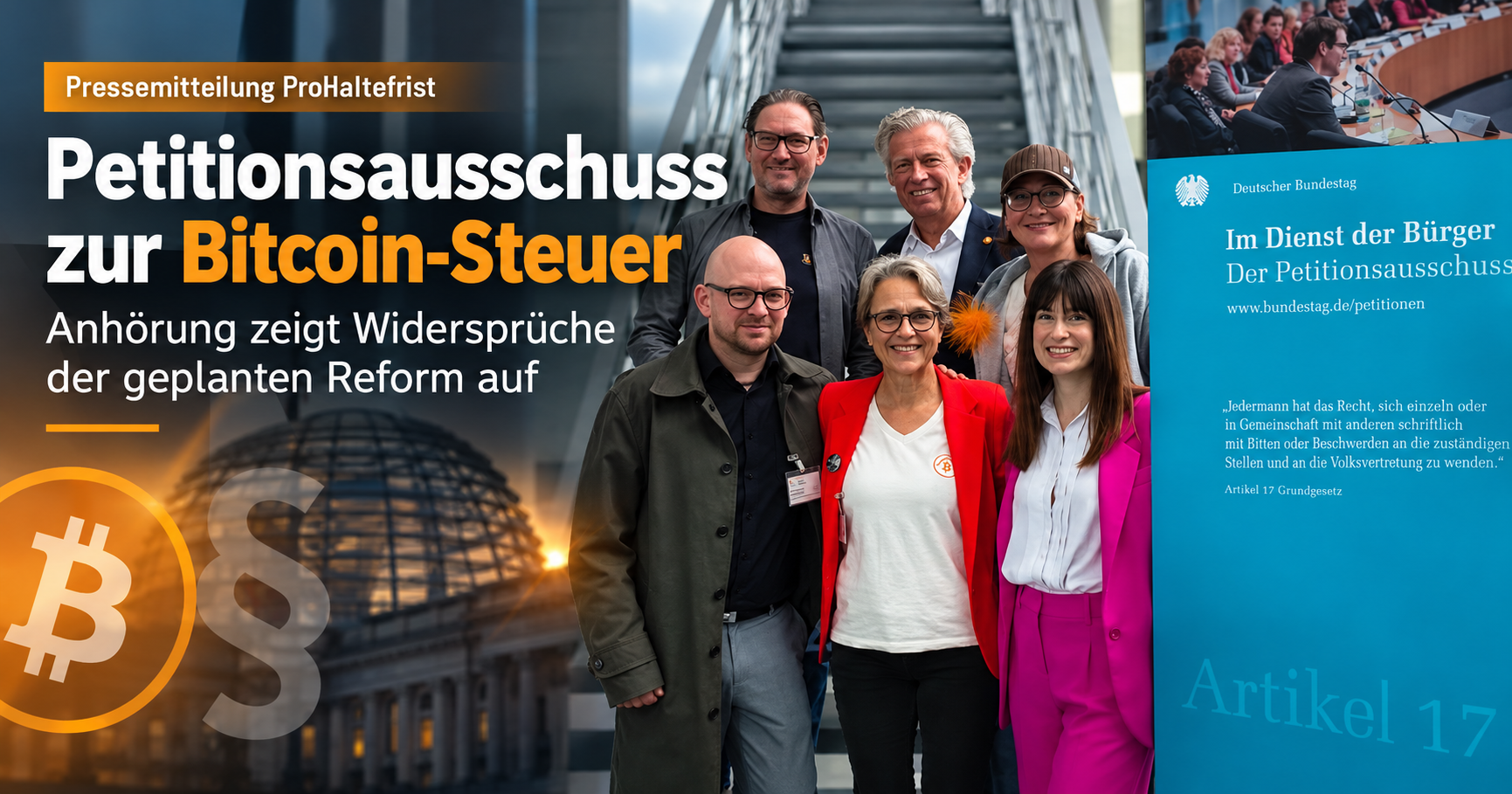
Berlin, October 12, 2026 – The planned abolition of the one-year tax holding period for Bitcoin and other cryptocurrencies sparked a controversial discussion on Monday in the German Bundestag’s Petitions Committee. Nicole Nowak, initiator of Petition 201716, and tax law expert Dr. Ingo Heuel presented the arguments of the ProHaltefrist initiative—supported by the German Bitcoin Association—to members of parliament and representatives of the Federal Ministry of Finance (BMF).
The main criticism centered on the fact that the planned reform could place a tax burden on long-term savers, of all people, while providing tax relief to high-income investors who trade in the short term. At the same time, discussions centered on the lack of a cost-benefit analysis, competitive disadvantages for German crypto service providers, and the differing tax treatment compared to gold.
The hearing also raised a more fundamental question: Could a new framework for crypto taxation have long-term implications for the tax treatment of other private assets, such as gold, art, and classic cars?
Nicole Nowak: “For many people, Bitcoin is a conscious, long-term savings decision.”
In a personal and emotional opening statement, Nicole Nowak made it clear that the debate extends far beyond wealthy crypto investors.
The business mathematician described her own family history. Her parents came to Germany from Silesia in the late 1980s and built a new life for themselves here. Today, in her educational work, she meets teachers, nurses, police officers, single parents, and retirees who are building up savings for their children or their own retirement through small, regular contributions.
“For these people, Bitcoin is not a tool for gambling or speculation, but a conscious, long-term savings decision,” Nowak explained to the committee.
She cited a 2024 survey by the European Central Bank: 54 percent of crypto owners surveyed in selected eurozone countries held less than 1,000 euros in crypto assets, and 91 percent held less than 20,000 euros.
Tax reform could benefit speculators rather than long-term savers
Nowak was particularly critical of the differing impacts of the planned reform on short-term and long-term investors.
Currently, gains from private Bitcoin sales within one year are generally taxed at the individual income tax rate. Once the holding period expires, gains are tax-free.
In contrast, the Federal Ministry of Finance’s draft bill dated September 30 provides that so-called exchange-based crypto assets will in the future be classified as income from capital assets under Section 20 of the Income Tax Act (EStG). Profits from cryptocurrencies acquired on or after 2027 would then generally be subject to a 25 percent capital gains tax plus the solidarity surcharge, regardless of the holding period.
“The reform could therefore provide tax relief to high-income short-term speculators, of all people, while placing an additional burden on long-term savers,” Nowak warned.
Dr. Ingo Heuel reiterated this criticism during the subsequent Q&A session. He noted that those who act on short notice could benefit from the flat-rate taxation. Investors who regularly purchase Bitcoin over many years, on the other hand, would lose their previous tax exemption.
Gold, Art, and Classic Cars: How Far Could a Tax Reform Go?
A significant portion of the hearing focused on the question of what consequences a change to the current tax system might have for other assets as well.
Under Section 23 of the Income Tax Act, private sales of so-called “other assets” are generally subject to a one-year holding period. In addition to Bitcoin, these have so far included, for example, physical gold, works of art, antiques, and—under certain conditions—privately owned classic cars. Once the holding period has expired, gains from such private sales may generally remain tax-free.
CSU Representative Heiko Hain therefore explicitly asked the Federal Ministry of Finance whether a change in the treatment of cryptocurrencies would not inevitably call into question the tax treatment of other asset classes as well.
Dr. Ingo Heuel referred to the existing legal framework: The legislature had deliberately chosen to treat private sales transactions involving various types of assets uniformly. An isolated exclusion of Bitcoin would therefore require a compelling justification. In this regard, he specifically cited gold, works of art, and classic cars.
Representatives of the Federal Ministry of Finance also acknowledged that drawing a clear distinction within Section 23 of the Income Tax Act (EStG) is difficult. As part of the discussions held so far with industry associations and state governments, proposals have already been received to extend tax changes to include gold as well. In addition, the question of whether the one-year holding period for other assets could be abolished altogether was raised as a fundamental alternative.
Such a general abolition is not the subject of this draft bill. However, the discussion highlights the broader tax law issues that could arise from a change to the current system.
If the one-year holding period were abolished for all affected private assets, capital gains from the sale of gold, works of art, antiques, or classic cars held for longer periods could also become taxable in the future, provided they fall under the relevant legal provisions.
Thus, the fundamental question regarding the future of the tax holding period extends beyond the Bitcoin and crypto markets.
Dr. Ingo Heuel Criticizes Lack of Cost Accounting and Competitive Disadvantages
Tax law expert Dr. Ingo Heuel, who provided technical guidance to the petitioner, questioned in particular the economic proportionality of the reform.
According to the draft bill, the Federal Ministry of Finance expects additional tax revenue that is projected to rise to approximately 350 million euros annually by 2031. As a percentage of total German tax revenue, this amounts to significantly less than 0.1 percent.
The draft bill has not yet quantified the additional burden this would place on tax authorities, companies, and investors.
Heuel also criticized the significant discrepancies between the revenue estimates being discussed in political circles. While the Federal Ministry of Finance (BMF) anticipates up to 350 million euros annually, other reform models cite revenues in the billions. Heuel explicitly questioned the data sources and comparability of these estimates.
Another point of criticism concerns competition between German and foreign crypto service providers. Certain domestic providers would be required to withhold capital gains tax directly in the future. Foreign providers without a corresponding German branch would not be subject to the same obligation.
The proposed substitute tax base of 50 percent of the sale proceeds—when acquisition costs cannot be verified—is considered particularly problematic. This could result in significant provisional tax withholdings.
Heuel fears this could lead to a shift toward foreign providers. At the same time, he pointed out that the European DAC-8 reporting requirements already provide comprehensive tools for ensuring tax transparency in crypto transactions.
The CDU/CSU and the Greens are also questioning the system change
The public hearing made it clear that the specific details of the BMF reform are raising questions even among lawmakers from different political parties.
In addition to the potential impact on other private assets, Heiko Hain (CSU) wanted to know what the future loss carryforward rules would look like and whether the Federal Ministry of Finance intended to take into account possible shifts to other markets.
Max Lucks (Alliance 90/The Greens) also criticized the Federal Ministry of Finance’s (BMF) plan to switch from Section 23 to Section 20 of the Income Tax Act (EStG). However, he did so from a different political perspective: The Greens support the elimination of the holding period but want to continue taxing crypto gains at the personal income tax rate.
Lucks criticized, in particular, what he saw as reduced legal certainty, new issues of fairness, and potential revenue shortfalls resulting from the switch to the flat-rate withholding tax.
SPD Member of Parliament Ruppert Stüwe, on the other hand, raised the fundamental question of why profits from cryptocurrencies should be treated differently for tax purposes than other capital gains.
In her response, Nicole Nowak once again emphasized the importance of private retirement savings. People should be able to decide for themselves whether to build wealth over the long term using ETFs, gold, or Bitcoin.
Heuel added that a new tax regulation does not automatically lead to greater fairness:
“You can’t supposedly close one gap in justice by creating many new gaps of injustice.”
Ministry of Finance Defends Reform, Leaves Other Options Open
Representatives of the Federal Ministry of Finance defended the planned system change. Cryptocurrencies have increasingly established themselves as tradable investments. Therefore, the Ministry believes that an explicit legal classification for the taxation of capital gains is appropriate.
In this context, the Federal Ministry of Finance (BMF) cited, among other examples, Austria, which has already implemented a similar reform.
However, it became clear during the discussion that the tax-law distinction between cryptocurrencies and other economic assets remains controversial. While the ministry is seeking to establish a new classification system for cryptocurrencies, members of parliament and petitioners pointed out the resulting difficulties in distinguishing them from gold and other assets.
The BMF representatives emphasized on several occasions that the draft was still undergoing inter-ministerial review and that the arguments presented could be incorporated into further deliberations.
The cabinet meeting is scheduled for Wednesday.
The Federal Cabinet is scheduled to discuss the draft legislation as early as October 14, 2026. No final decision on the petition was reached on Monday.
The ProHaltefrist initiative is calling on the federal government and the coalition parties to take the arguments presented at the public hearing into account in their further deliberations and to maintain the existing one-year holding period.
Nicole Nowak summarized her criticism at the end of her speech: “The planned reform shifts the burden in the wrong direction. It creates the wrong incentives, adds unnecessary red tape, and ultimately even encourages short-term speculation by high-income earners. And all of this for tax revenue that is minimal in relative terms.”
Her closing appeal: “The current regulation establishes clear and fair guidelines. That is why we call for it to be retained and for the planned elimination of the one-year holding period to be rejected.”
About ProHaltefrist
ProHaltefrist.de is a nonpartisan initiative aimed at preserving the tax holding period for private sales of cryptocurrencies. The campaign is supported by the Bitcoin Bundesverband and numerous companies, associations, and individuals from the Bitcoin and crypto ecosystem.
Petition 201716 reached the required quorum of 44,439 signatures for a public hearing before the Petitions Committee of the German Bundestag.
Additional Information and Sources
German Bundestag: Petition 201716 and Public Hearing on October 12, 2026
Federal Ministry of Finance: Draft Bill on the Reform of the Taxation of Certain Cryptocurrencies in Private Holdings, September 30, 2026
European Central Bank: Financial Stability Review, May 2025
Federal Finance Court: Ruling of February 14, 2023, IX R 3/22
Fritz Güntzler, Member of the Bundestag: Public statement on abgeordnetenwatch.de, May 19, 2026
Video: https://www.bundestag.de/dokumente/textarchiv/2026/kw42-pa-petitionen-1221702
Image material: Attached; free to use with attribution: ProHaltefrist.de Initiative
NicoleNowak_Petition_InitiativeProHaltefrist