
Bitcoin mining in the energy system:
Flexibility option for a renewable future
The transformation of the energy system towards renewable sources brings with it new challenges. One of these is becoming increasingly apparent: the discrepancy between electricity generation and actual demand.
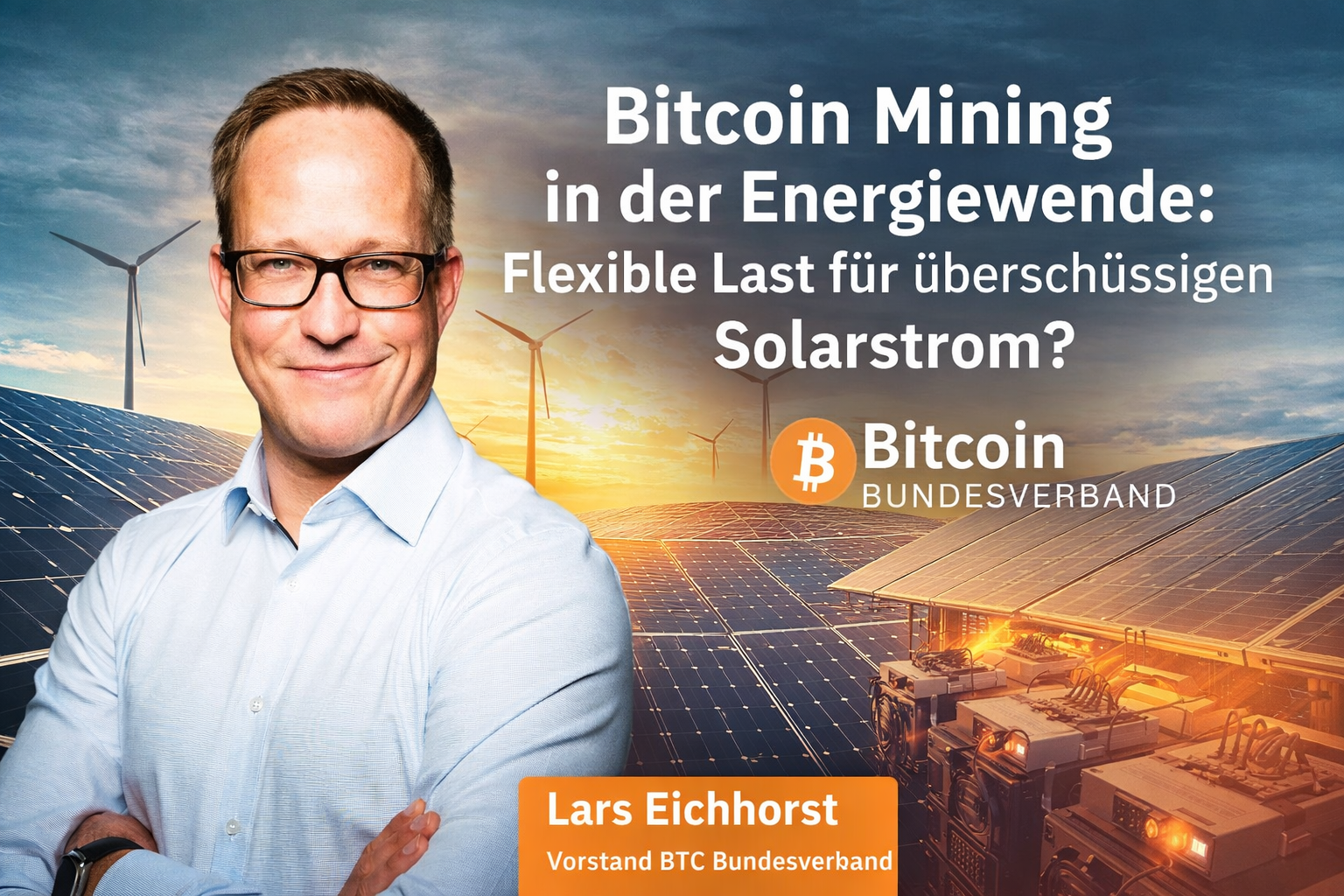
A recent technical article by Lars Eichhorst, board member of the Bitcoin Bundesverband and member of the Energy, Mining & ESG Committee, puts this development into perspective and sheds light on the potential role of Bitcoin mining in network congestion management.
The full technical article is available here:
https://www.energie.de/et/news-detailansicht/nsctrl/detail/News/zuschaltbare-lasten-im-netzengpassmanagement-asic-mining-als-flexibilitaetsressource-nach-13k-enwg
Growing electricity surpluses in the renewable energy system
With the expansion of photovoltaics, electricity production from renewable energies continues to increase significantly in Germany. At the same time, current data shows that a growing proportion of this energy cannot be used.
In 2025, the redispatch volume for photovoltaic systems increased significantly. At the same time, the number of hours with negative electricity prices increased. One of the reasons for this is a significant increase in capacity with limited grid and storage options.
This development points to a structural problem: renewable energy is increasingly available at times and in places where it cannot be fully absorbed.
Limits of existing solutions
Various approaches are being discussed and implemented to overcome these challenges:
- the expansion of the electricity grids
- the use of battery storage systems
- the use of hydrogen as a long-term storage medium
These options are important components of the energy transition, but face economic and time limits in their practical implementation. There is still a need for flexibility, particularly in the case of short-term and regional surpluses.
Controllable loads within the regulatory framework
Section 13k of the Energy Industry Act (“Utilization instead of curtailment”) has created a regulatory framework that specifically addresses this problem. The aim is no longer to reduce surplus electricity solely by curtailing generation plants, but to make it usable by using additional consumers.
These so-called controllable loads can be activated specifically when there is an abundance of electricity, thus helping to stabilize the system.
Bitcoin mining as a flexibility option
Lars Eichhorst’s article examines the extent to which Bitcoin mining can be used as such a controllable load.
In technical terms, ASIC-based mining systems are characterized by their high reaction speed and flexibility. They can be started up and shut down within short periods of time and are therefore generally suitable for use in dynamic network situations.
Another aspect is energy utilization: a large proportion of the electrical energy used is converted into heat, which can be reused in suitable applications such as heating buildings or in industrial processes.
Integration into the energy system
The discussion about Bitcoin mining is often focused on energy consumption. This article suggests that a more differentiated view is necessary.
In the context of an energy system with structural surpluses, the question cannot just be how much energy is consumed, but also whether and how this energy can be used sensibly.
Controllable loads such as mining applications could play a supplementary role in this context, especially where other flexibility options are not economically or technically available.
Expertise in the Bitcoin Bundesverband
As part of its Energy, Mining & ESG Committee, the Bitcoin Bundesverband deals intensively with the interactions between Bitcoin, energy infrastructure and the regulatory framework.
The aim is to provide fact-based support for the debate and bring together different perspectives from technology, the energy industry and practice. With experts such as Lars Eichhorst, the relevant expertise is represented both in the association and on the board.
Conclusion
The increasing electricity surpluses resulting from the expansion of renewable energies pose new challenges for the energy system. In addition to traditional solutions, flexible consumption options are increasingly coming into focus.
Bitcoin mining can represent such a flexibility option under certain conditions. The technical suitability has been proven, and regulatory integration is currently undergoing further development.
Whether and to what extent this approach will prevail will largely depend on market conditions and the further development of the regulatory framework.
For a more in-depth analysis, we recommend reading the full technical article by Lars Eichhorst: Zuschaltbare Lasten im Netzengpassmanagement: ASIC-Mining als Flexibilitätsressource nach § 13k EnWG