
Strait of Hormuz: Bitcoin as a means of payment in a geopolitical field of tension
The Strait of Hormuz is one of the most sensitive and important trade routes in the world. A significant proportion of the global oil trade is handled via this strait – its geopolitical importance is correspondingly high.
In the current situation between the USA and Iran, the focus is shifting to an aspect that goes beyond traditional security policy issues: payment processing.
Toll claims – and Bitcoin as a payment option
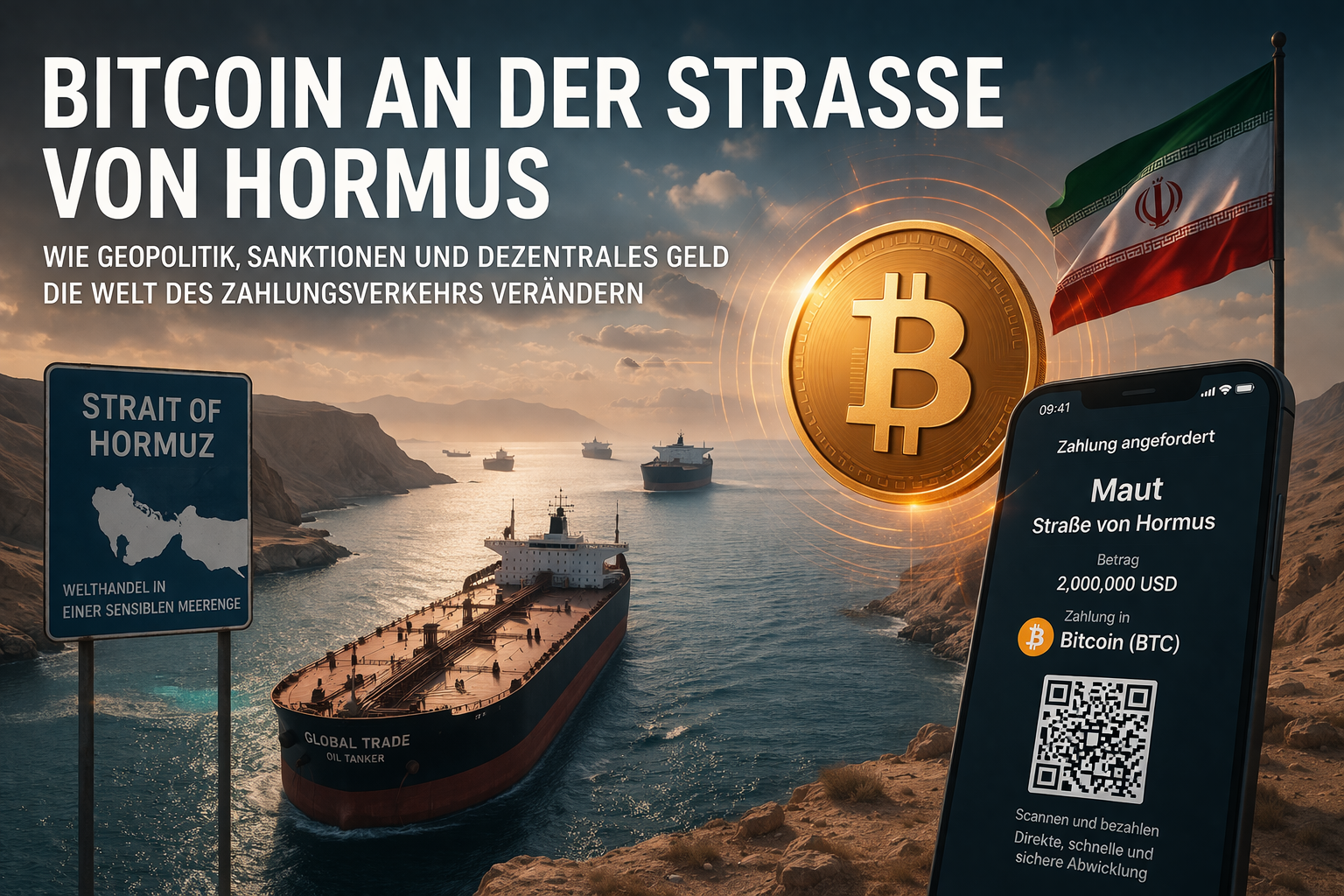
According to media reports, Iran is currently demanding a toll from shipping companies for the passage through the Strait of Hormuz. It is not so much the demand itself that is controversial, but the way it is being handled.
Accordingly, the fees are to be paid partly in Bitcoin.
For tankers with large freight volumes, these payments can quickly add up to millions. At the same time, traditional payment channels are largely blocked by international sanctions. Transactions in US dollars or via the SWIFT system are effectively not an option for many market participants.
Against this backdrop, the use of Bitcoin appears to be a pragmatic solution.
Payment processing by e-mail and wallet
The operational implementation described is particularly noteworthy.
According to reports, shipowners receive an email from Iranian authorities after registering their cargo. After checking the details, a request for payment follows – apparently including the necessary information for a Bitcoin transaction.
The transaction is then processed directly via digital wallets. In some cases, it is described that there is only a very short time window for payment.
The aim of this approach is apparently to process payments quickly, directly and outside of traditional financial structures. At the same time, the aim is to avoid transactions being recorded, blocked or tracked in the traditional financial system.
Why reversals are a problem in the traditional system
Another aspect is particularly relevant in this context: the possibility of reversals and interventions in payments.
In the traditional financial system, international transactions are often not final. Banks can freeze, stop or – particularly under regulatory or political pressure – subsequently reverse payments. In the case of US dollar payments in particular, the central role of American banks and clearing houses means that transactions can be blocked or reversed.
This represents a considerable risk for countries such as Iran. Even if a payment has been technically triggered, there is no guarantee that it will finally reach the recipient or remain there.
Bitcoin works in a fundamentally different way:
- Transactions cannot be reversed unilaterally after confirmation in the network
- There is no central authority that can stop or freeze payments
- Settlement takes place independently of banks and state-controlled systems
It is precisely these characteristics that make Bitcoin particularly attractive in a sanctions environment.
Bitcoin as a functioning alternative
Against this backdrop, it becomes clear why Bitcoin plays a role in the current situation.
If a country is excluded from the SWIFT system and traditional bank transactions do not function reliably or are politically vulnerable, there is inevitably a need for alternative solutions.
Bitcoin offers an infrastructure that:
- functions independently of existing financial networks
- cannot be controlled by individual states
- enables final processing of payments
Bitcoin is thus potentially developing into a tool for countries that are excluded from the traditional financial system or deliberately want to bypass it.
From theoretical application to concrete use
It has long been discussed whether and to what extent Bitcoin can play a role in international trade. Current developments surrounding the Strait of Hormuz show that such scenarios are no longer purely theoretical.
For the first time, Bitcoin is specifically mentioned as a means of payment in connection with one of the most important global trade routes – not in a private context, but in the context of government requirements.
A signal for global payment transactions
The processes can be interpreted as part of a larger trend. In a world that is increasingly characterized by geopolitical tensions and regulatory fragmentation, the need for alternative payment channels is growing.
In this context, Bitcoin is not used as a replacement for existing systems, but as a supplementary infrastructure that functions independently of state currencies and traditional financial networks.
Conclusion
The reports of Bitcoin payments in connection with the Strait of Hormuz mark a remarkable development.
They show that Bitcoin is increasingly being used where traditional payment methods are reaching their limits. Even if many details are currently not publicly verifiable, one thing is clear:
Bitcoin is no longer just an investment instrument, but is gradually developing into a practically used system for international payments.
This role could become even more important in geopolitically tense situations.