
Is the digital euro also digital cash?
Digital euro: Between aspiration and reality
The discussion about the digital euro is gaining momentum. Institutions such as the European Central Bank (ECB), national central banks and civil society organizations are driving the project forward. The citizens’ movement Finanzwende is currently also actively campaigning for broad support – including through a petition for a “sovereign Europe”.
In principle, it is legitimate to advocate new forms of state digital means of payment. However, especially for a project with such far-reaching social implications, the focus should be on one thing: an open, critical and fact-based debate.
This is precisely what is often lacking at the moment.
Lack of justification: Which problem is to be solved?
One central question remains unanswered to this day: What specific problem does the digital euro actually solve?
- Payment transactions in Europe work.
- Digital means of payment are already widespread.
- Cash is still available.
Neither a clear market failure nor an acute systemic risk is convincingly named. Instead, reference is often made to geopolitical developments – such as dependence on non-European payment providers or political uncertainties.
But geopolitical arguments are no substitute for sound economic necessity.
A project of this magnitude should not be based on abstract future scenarios, but on clearly identifiable problems.
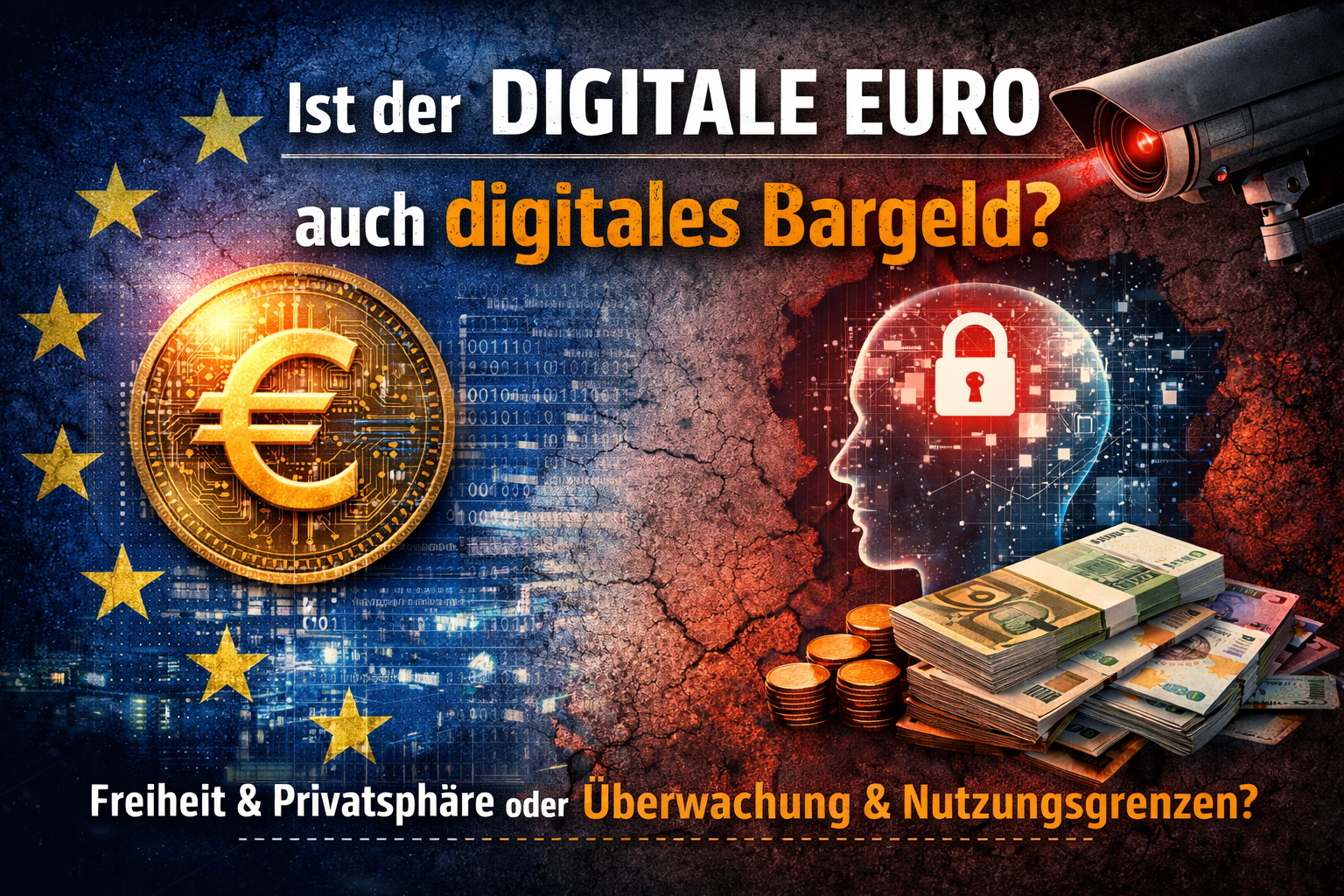
The myth of “digital cash”
A central narrative of the proponents is that the digital euro is a “digital twin” of cash.
On closer inspection, however, this comparison does not hold up.
Cash is characterized by features that are not provided for in the digital euro:
- Unrestricted use – regardless of location and technical infrastructure
- No upper limits for ownership or transactions
- Anonymous use without traceability
- Direct availability without intermediaries
The digital euro, on the other hand, would be:
- geographically and regulatory limited
- technically controllable
- potentially provided with upper holding limits
- tied to digital end devices and infrastructure
It is therefore not a digital twin – but a fundamentally different system.
Or to put it another way: if cash means freedom in payment transactions, then the digital euro is more of a regulated instrument within an existing system.
Costs: Who pays for the infrastructure?
Another point that is often played down is the cost.
Estimates range from several billion euros for development and introduction to ongoing operating costs in the hundreds of millions per year.
Regardless of the exact amount:
These costs do not disappear – they are borne by:
- Taxpayers
- Bank customers
- The company
The often implicit statement that the digital euro is “free” falls short of the mark. It is a large-scale infrastructure project that will ultimately be financed by society.
This is precisely why transparency and an honest cost-benefit analysis are needed.
Sovereignty: a contradictory argument
One argument often put forward is Europe’s financial sovereignty.
The digital euro is intended to help become more independent of US payment service providers such as Visa or Mastercard.
But this argument is only partially convincing.
Because a digital euro would also be dependent on:
- Smartphones and operating systems from international manufacturers
- Global semiconductor and infrastructure chains
- Existing digital platforms
As long as Europe does not develop its own competitive technological basis in these areas, its sovereignty in payment transactions will remain limited.
The digital euro does not solve this structural problem – it merely shifts it.
Cash: no bans, but creeping displacement
Officially, it is emphasized that the digital euro is intended to supplement cash and not replace it.
But the reality is already showing a different trend:
- More and more services can only be used without cash
- Cash infrastructure is being dismantled economically
- Social habits are changing
The danger lies not in a sudden ban, but in a creeping suppression.
Particularly affected are:
- older people
- Technologically less affine groups
- People without access to digital infrastructure
A digital payment system must not lead to social exclusion.
A digital payment system must not lead to social exclusion.
Another critical point is data protection.
It is politically emphasized that the digital euro should not be “programmable money” and that privacy should be preserved. However, the decisive factor is not the political intention, but the technical reality.
If a system is fundamentally capable:
- Tracking transactions
- Enforce usage rules
- Control access centrally
then there is always the possibility that these functions will be used or expanded in the future.
History shows that once technical possibilities have been created, they rarely remain unused.
Trust in institutions is important – but is no substitute for robust, technically anchored civil liberties.
The real challenge: design instead of approval
The debate about the digital euro should not be reduced to the question of whether one is “for” or “against” it.
The crucial question is:
How should a digital means of payment be designed so that it comes as close as possible to the properties of cash?
These include in particular
- Real privacy in payment transactions
- No arbitrary restrictions on use
- Broad accessibility without technical hurdles
- Clear limitation of state intervention
A digital euro that does not meet these criteria would not be progress – but a step backwards in terms of financial self-determination.
Conclusion: More open debate, less activism
The digital euro is one of the most important monetary policy projects of our time. This makes it all the more important to have a balanced discussion that highlights the opportunities and risks in equal measure.
Civil society organizations can play an important role here – provided they maintain their critical distance.
A project of this scope does not need campaigns designed to generate approval.
It needs a broad, honest and controversial debate.
Because in the end, it’s about more than just a new means of payment.
It’s about the question of how much freedom will be preserved in the digital monetary system of the future.