
Accepting Open Bitcoin Payments – Why Germany Must Set the Right Course Now
The German Bitcoin Association advocates for an open Bitcoin payment system
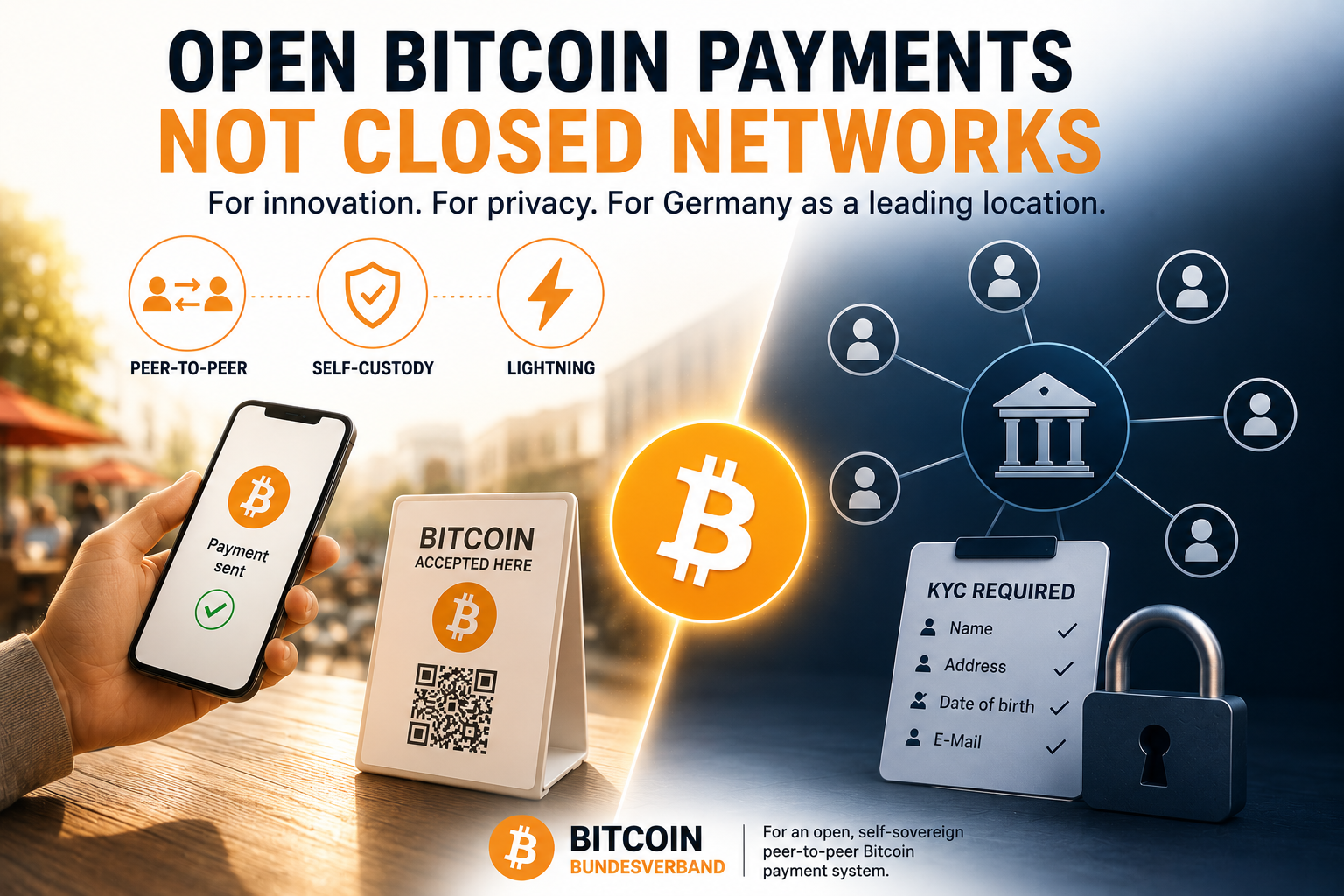
Bitcoin was originally developed as a peer-to-peer electronic cash system. The idea was that anyone should be able to pay any other participant directly using their wallet—without closed networks and without central intermediaries.
It is precisely this openness that makes Bitcoin a unique innovation.
However, we are currently seeing a trend that could change this fundamental principle.
More and more Bitcoin payment providers are evolving into closed, account-based payment systems. At the same time, regulatory uncertainties surrounding self-custody and the Lightning Network are on the rise.
The German Bitcoin Association views this development with concern and is committed to ensuring that Europe—and Germany in particular—remains a place that fosters innovation for open Bitcoin payments.
Developments in the United States
A look at the U.S. already gives us an idea of where the market might be headed.
Many well-known Bitcoin payment providers there already operate using a closed-account model.
These include, among other things:
- BitPay
- Coinbase Commerce
- Crypto.com Pay
- Binance Pay
The process is similar to that of a traditional credit card system.
The merchant has an account with the respective payment provider.
The payer must also have an account with that exact provider and must first complete the identity verification process (KYC).
Payment can be made only after that.
Technically, Bitcoin is used.
In practice, however, the payment takes place within a closed network.
For the user, this means:
If you want to pay at a retailer, you often have to use the exact same payment provider that the retailer uses.
This contradicts the original idea of an open Bitcoin network, in which every wallet should be interoperable with every merchant.
Is this trend also emerging in Europe?
The first signs of a similar trend are also evident in Europe.
One example is the Danish payment provider Coinify.
Coinify states on its website that the payer’s personal data is collected in accordance with the Travel Rule.
These include, among other things:
- full name
- Email address
- Home Address
- Date of birth
- Wallet Type
- Wallet address or exchange used.
This data is either transmitted to Coinify by the merchant or requested directly from the payer during the payment process.
Coinify creates its own customer dataset for this purpose and can identify repeat payers using a customer ID.
The key question, therefore, is:
Is this merely a particularly conservative implementation of regulatory requirements, or is an account-based payment model gradually taking shape in Europe as well?
From the outside, it is not currently possible to provide a definitive answer to this question.
One thing is certain, however:
For the payer, this approach means that personal data is also transmitted to a payment service provider—even though the merchant may not actually need this information.
Why This Development Should Be Viewed Critically
The German Bitcoin Association supports effective measures against money laundering and terrorist financing.
However, regulation must not result in Bitcoin losing its essential characteristics.
When paying at a brick-and-mortar store, no one expects a customer to first, when buying a cappuccino,
- his name,
- his address,
- his email address
- and his date of birth
must transmit to a payment service provider.
Such a process would be neither practical for everyday use nor data-privacy-friendly.
Bitcoin payments must remain at least as easy to use as card payments or contactless payments.
Self-custody must be maintained even when making payments
The Bitcoin Federal Association is a strong advocate for self-custody.
This doesn’t just apply to Bitcoin storage.
The same applies to Bitcoin payments.
A user who holds their own Bitcoin and sends it directly to a merchant should not be required to automatically provide their personal data to another intermediary unless required by law.
Merchants should also retain the option to receive Bitcoin directly into their own wallets.
Self-custody must be maintained for both parties to the payment transaction.
Lightning is a technology of the future
In addition to the shift toward account-based payment systems, we are observing a second trend.
Several European Bitcoin companies report that they have already integrated the Lightning Network from a technical standpoint but have not yet actively offered the feature due to regulatory uncertainties.
No official position on this matter has been made public by the relevant regulatory authorities.
However, feedback from the industry shows that regulatory uncertainty is already affecting innovation today.
That would be unfortunate.
Lightning is one of the most exciting innovations in the Bitcoin ecosystem.
It allows you to:
- Payments within seconds,
- virtually no transaction costs,
- Micropayments,
- Machine-to-machine payments,
- AI Agent Payments,
- New business models for the digital economy.
Germany and Europe should actively promote this development rather than inadvertently hinder it.
Germany must not create a competitive disadvantage
MiCA aims to create a unified European single market.
However, if certain national supervisory authorities interpret regulatory requirements in a significantly more restrictive manner than other Member States, this could result in unintended competitive disadvantages.
Innovative companies would first develop and offer new products in other European countries.
Instead, Germany should be an attractive location for Bitcoin and Lightning innovations.
Technology-neutral—legally sound—and competitive.
Our Demands
The German Bitcoin Association is therefore committed to ensuring that:
- Bitcoin will remain an open peer-to-peer payment system in the future.
- Self-custody remains fully available to both payers and merchants.
- Personal data is collected only where required by law and where such collection is proportionate.
- Regulatory requirements should be interpreted as uniformly as possible across Europe.
- to avoid national exceptions that would put Germany at a disadvantage as a hub for innovation.
- the Lightning Network is being actively promoted as a technology of the future.
- open and interoperable Bitcoin payments are not disadvantaged compared to closed, account-based systems.
Conclusion
Europe is facing an important decision.
Bitcoin can either evolve into yet another closed payment network—similar to the well-known credit card systems—or retain its original strength: an open, interoperable peer-to-peer payment system based on self-determination, privacy, and technical innovation.
The German Bitcoin Association will work to ensure that regulation and innovation are not mutually exclusive.
Germany has the opportunity to become a leading hub for Bitcoin and Lightning payments. To achieve this, it needs regulations that effectively combat money laundering without unnecessarily restricting open networks, self-custody, and user privacy.
Further Information: Are Bitcoin payments evolving into closed payment networks?