

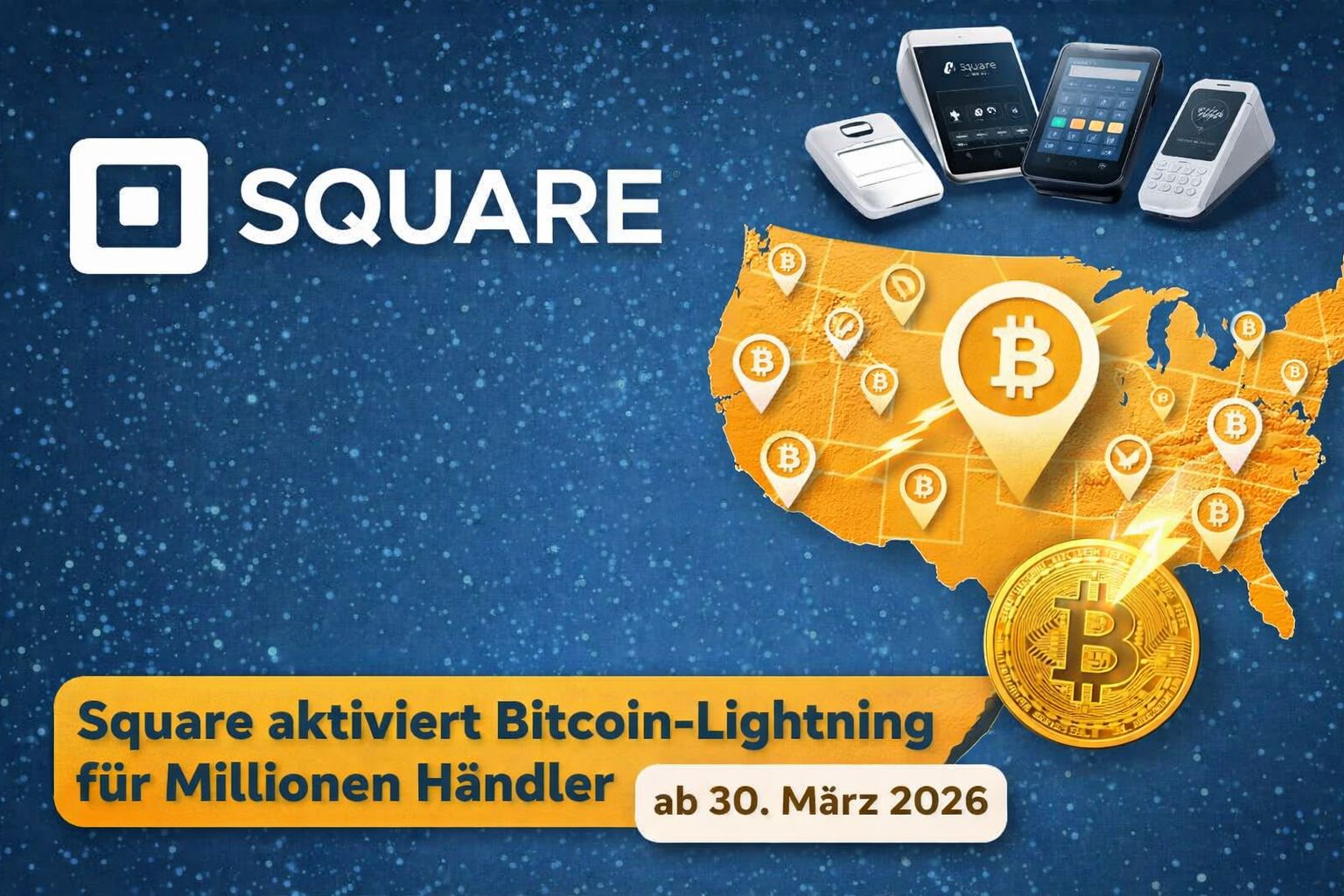
Square enables Bitcoin Lightning payments for millions of merchants in the US
Square will enable Bitcoin payments via the Lightning Network by default for eligible merchants from March 30, 2026. This could technically enable millions of businesses in the USA to accept Bitcoin. Why this is so important for Bitcoin as a means of payment and what Germany can learn from it.
From March 30, 2026, Square will enable Bitcoin payments via the Lightning Network by default for eligible merchants in the US. This could technically enable millions of brick-and-mortar stores and businesses to accept Bitcoin payments in one fell swoop.
This is a significant step for Bitcoin as a means of payment. This is because it is no longer individual pilot projects or specialized providers that are driving development, but one of the major payment service providers in US commerce. If Bitcoin payments are integrated directly into existing checkout systems, the chance that Bitcoin can actually be used in everyday life increases.
What is Square?
Square is a US payment service provider and is part of the Block company. The provider is primarily known for its card terminals, checkout systems and payment processing for merchants. Small and medium-sized companies in the USA in particular use Square in stationary retail, cafés, restaurants, stores and service providers.
For German readers, Square is best compared to SumUp. SumUp also offers card readers, point-of-sale solutions and payment processing for merchants. While SumUp is better known in Germany and Europe, Square plays a similar role in the US. This is why Square’s announcement is so relevant from a Bitcoin perspective: It does not concern a niche solution, but a payment infrastructure that is already widely used.
What exactly will change from March 30, 2026?
According to the information available, Square wants to activate Bitcoin Lightning payments by default for authorized merchants. This means that merchants no longer have to actively activate the function themselves, but will automatically receive it as an available payment option. Those who do not wish to do so can deactivate the function.
This is an important difference to the previous situation. Until now, merchants had to consciously activate Bitcoin payments manually and actively deal with the question of whether they wanted to keep Bitcoin or convert it directly into US dollars. In future, Bitcoin payments will become more of a normal default setting within the payment infrastructure.
How does it work for retailers?
From a merchant’s point of view, the crucial point is that the complexity remains in the background. Customers can pay with Bitcoin via the Lightning Network, while the merchant can still simply receive US dollars into their bank account if they wish.
This is crucial for acceptance. Many merchants are generally open to new payment methods, but do not want to bear exchange rate risks or create additional tax or accounting complexity. If Bitcoin is automatically converted into fiat money in the background, this hurdle is significantly lowered.
In other words, the merchant does not need to be a Bitcoin expert to accept Bitcoin payments.
Why is Lightning so important?
The Lightning Network is an additional Bitcoin payment layer for fast and cost-effective transactions. This is particularly relevant for brick-and-mortar retail, as payment transactions at the checkout must be instant, reliable and with low fees.
This is precisely the practical significance of the Square integration. Bitcoin is not integrated as a slow or complicated special payment, but via a network that is suitable for everyday use in retail. This makes Bitcoin payments at the checkout more realistic on a large scale for the first time.
Why is the Square decision so important for Bitcoin?
The real significance lies not only in the technology, but in the distribution via existing merchant networks. If a major payment provider integrates Bitcoin Lightning payments directly into its standard infrastructure, this changes the starting point for the entire debate about Bitcoin as a means of payment.
Until now, Bitcoin payments in retail have often been seen as a special case: technically interesting, but only relevant for particularly committed merchants. Square is changing this perception. Bitcoin is no longer just being tested by individual pioneers, but can become part of a widespread standard offering in retail.
That is a fundamental difference.
What do 4 million merchants mean for Bitcoin acceptance?
The figure of around 4 million Square merchants illustrates the potential scale. Even if not every merchant actively uses the function or advertises it visibly, the theoretical number of possible Bitcoin acceptance points increases massively.
This is relevant for Bitcoin adoption for several reasons:
Firstly, the visibility of Bitcoin as a means of payment is increasing.
Secondly, the practical usability in everyday life is growing.
Thirdly, merchants do not have to set up their own Bitcoin infrastructure.
Fourthly, Bitcoin payments are increasingly perceived as a normal payment option.
Acceptance is not only created by the fact that a merchant could “somehow” accept Bitcoin. It is crucial that Bitcoin becomes available where real payment flows are already taking place: at existing cash registers, in familiar terminals and in real retail environments.
Why is this particularly relevant for the USA?
The USA is particularly important for Bitcoin as a payment market because large payment service providers, tech platforms and consumer behavior often set new standards there early on. If Bitcoin runs as standard in millions of POS systems via Square, this also sends a signal to other providers, competitors and merchants.
It shows: Bitcoin payments do not have to take place outside the established payment market. They can become part of the same infrastructure that is already used for card and mobile payments today.
This increases the likelihood that Bitcoin will increasingly be perceived in public discourse not only as an investment, but also as a functioning payment infrastructure.
The development fits in with the River Study 2026
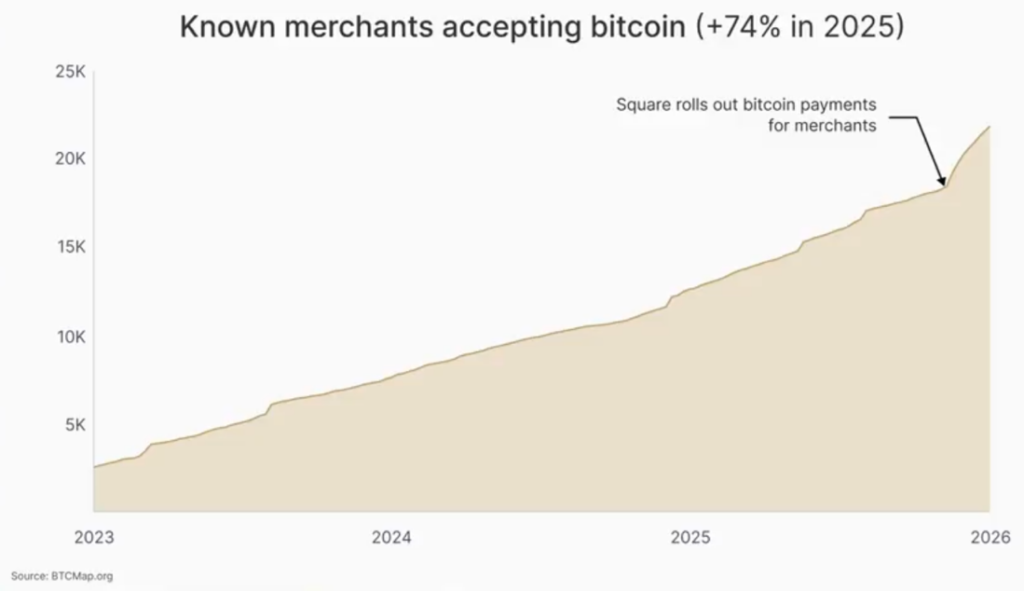
Square’s announcement fits in with a trend that is also described in the River Study on Bitcoin Adoption 2026. There it is pointed out that the number of known merchants accepting Bitcoin continues to increase.
This is exactly where Square comes in: Rather than individual new Bitcoin stores emerging in isolation, an existing payment network is opening up to Bitcoin Lightning payments by default. This accelerates development significantly more than many smaller individual initiatives.
The statement is therefore more than just a product update at Square. It shows how Bitcoin acceptance can grow in the mass market: through integration into existing merchant processes, not just through specialized stand-alone solutions.
What does this mean for Germany and Europe?
Even though Square is much less well known in Germany than SumUp, the development is highly interesting for Europe. It shows how Bitcoin payments become relevant when they are integrated into existing checkout systems without friction losses.
An important insight can be derived from this for the German market: Bitcoin payments will not only become suitable for everyday use when every merchant manages wallets themselves or bears exchange rate risks. Rather, it is crucial that payment providers take over the technical integration and enable simple processing for the merchant.
This is precisely the strategic importance of the Square decision.
Bitcoin gains legitimacy as a means of payment
The more real points of acceptance there are, the more difficult it becomes to portray Bitcoin solely as an object of speculation. Where Bitcoin can actually be used for goods and services, economic use arises. And economic use strengthens the legitimacy of Bitcoin as part of modern payment infrastructure.
Square is helping to make this use more visible and scalable. This is therefore an important moment in the debate about Bitcoin payments.
Conclusion: A big step for Bitcoin payments in everyday life
The activation of Bitcoin Lightning payments at Square is far more than a technical side note. It shows how Bitcoin payments can grow in everyday life: not via complicated special solutions, but via existing merchant networks and familiar checkout systems.
For millions of US merchants, Bitcoin could thus at least technically become an available standard option. And for Bitcoin as a whole, this is a strong signal: its role as a means of payment continues to gain practical relevance.
The River Study 2026 already points to growing Bitcoin acceptance points. Square could now provide an example of how quickly this trend can accelerate if major payment providers integrate Bitcoin directly into their systems.
To the River Study Bitcoin Adaption 2026: https://river.com/content/bitcoin-adoption-2026
Coincharge: Bitcoin Acceptance 2026
What is Square?
Square is a US payment service provider from Block. The company offers checkout systems, card terminals and payment processing for merchants. In Germany, Square is most comparable to SumUp.
What are Square’s plans for Bitcoin payments?
Square plans to enable Bitcoin payments via the Lightning Network for eligible merchants by default from March 30, 2026. Merchants can deactivate the function if required.
Do retailers have to set something up for this?
According to the announcement, the function will be activated automatically. This means that merchants no longer have to activate Bitcoin payments manually, but can switch them off.
Are merchants paid out in Bitcoin or in US dollars?
Merchants will still have the option of having incoming Bitcoin payments automatically converted into US dollars. As a result, they will receive fiat money in their bank account as with other payment methods.
Why is the Lightning Network important for retailers?
The Lightning Network enables fast and cost-effective Bitcoin payments. This is particularly important for brick-and-mortar retail, where payments at the checkout need to work immediately and reliably.
Why is the Square integration relevant for Bitcoin?
Because Bitcoin is not only integrated into special solutions, but also into an existing merchant infrastructure. This significantly increases the potential reach and visibility of Bitcoin as a means of payment.
What does the figure of 4 million retailers mean?
The figure shows the potential scale of the integration. Even if not all merchants actively use the function, the potential number of Bitcoin acceptance points increases considerably.
Why is this also interesting for Germany?
Although Square is less well-known in Germany than SumUp, the development shows how Bitcoin payments can become suitable for mass use: through simple integration into existing checkout systems and automatic payment in fiat money.
Does the Square announcement fit in with the River Study 2026?
Yes, the River study describes that the number of known Bitcoin acceptance points is growing. Square could accelerate this development because a large payment provider is bringing Bitcoin directly into its existing merchant base.
Is this a breakthrough for Bitcoin as a means of payment?
It is definitely an important step forward. The integration into a large merchant network increases the practical usability of Bitcoin in everyday life and strengthens the perception of Bitcoin as a payment infrastructure.