
Strategic potential of Bitcoin
Motion in the Bundestag on the “strategic potential of Bitcoin” on Dirk Brandes’ speech
Classification from the perspective of the Bitcoin Bundesverband
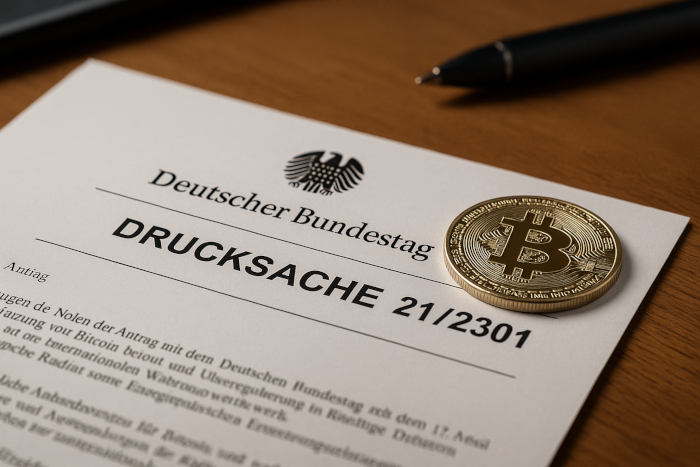
On October 17, 2025, the German Bundestag was presented with a motion in printed matter 21/2301 entitled
“Recognizing the strategic potential of Bitcoin – preserving freedom through restraint in taxation and regulation”.
The motion was submitted by members of the AfD parliamentary group. The paper deals with the classification of Bitcoin in terms of monetary theory, its role in international currency competition, European regulation (MiCA), tax issues and possible fields of application in energy and technology policy.
The Bitcoin Bundesverband does not evaluate the content of this motion. However, we welcome the fact that Bitcoin is being discussed as an independent topic in the German Bundestag and has been placed on the agenda for the 21st parliamentary term. We will follow how other parliamentary groups and members of parliament react to the proposed points and which aspects are included in future debates and legislative procedures.
Abstract
- A motion has been tabled in the German Bundestag that emphasizes the strategic potential of Bitcoin and warns against overregulation.
- The core topics are: Differentiation of Bitcoin from other crypto-assets, implementation of MiCA, tax clarity as well as energy and location issues.
- From the perspective of the Bitcoin Bundesverband, it is positive that Bitcoin is being seriously discussed as an independent technology and that topics such as innovation protection, legal security and energy integration are being addressed.
- At the same time, we see a need for optimization in the differentiation of the arguments, particularly with regard to energy, regulation and international classification.
- We welcome the debate in the Bundestag and are available to all democratic players as an expert point of contact in order to advance the content of the discourse.
1. background and content of the application
On October 17, 2025, the German Bundestag was presented with a motion in printed matter 21/2301 entitled
“Recognizing the strategic potential of Bitcoin – preserving freedom through restraint in taxation and regulation”.
The application:
- describes Bitcoin as a decentralized, scarce, digital money that is clearly different from other crypto-assets,
- criticizes possible overregulation in the course of implementing the MiCA Regulation,
- calls for tax clarity for privately held Bitcoin,
- emphasizes the potential contributions of Bitcoin mining to energy and location issues,
- and demands a strategic statement from the German government on the role of Bitcoin.
The Bitcoin Bundesverband does not assess the motion in terms of party politics, but rather classifies the content against the background of its mission and positions.
We welcome the fact that Bitcoin is being discussed in the Bundestag on a substantive level and will observe which aspects are adopted by other parliamentary groups in future debates and legislative initiatives.
2. central points of the application
2.1 Differentiation of Bitcoin in the MiCA context
- Bitcoin is described as a separate category within digital assets.
- The MiCA Regulation is understood to primarily address centralized issuers, custodians and platforms.
- Fully decentralized protocols such as Bitcoin should not be placed in the same regulatory framework as centrally controlled projects without necessity.
2.2 Regulation and infrastructure
The application warns against treating the basic infrastructure of the Bitcoin network like traditional financial intermediaries, in particular:
- non-custodial wallets,
- Lightning Nodes and other decentralized services,
- Infrastructure tools that do not manage third-party funds.
The fear is that excessive regulation could drive open source development, innovation and start-ups in this area out of Germany.
2.3 Tax treatment
The main requirements are:
- the confirmation and clarification of the twelve-month holding period for privately held Bitcoin,
- a clear legal separation of Bitcoin and other crypto-assets,
- the avoidance of a blanket classification of small, private mining or lightning operations as a business.
The aim is to increase legal certainty for citizens and investors.
2.4 Energy, location and digital sovereignty
The application emphasizes:
- the potential role of Bitcoin mining as a flexible load in the energy system,
- the use of surplus electricity and the integration of renewable energies,
- the importance of Bitcoin in international currency and location competition,
- and Bitcoin as an instrument for strengthening the digital and financial sovereignty of citizens.
3. what we welcome in terms of content
From the perspective of the Bitcoin Bundesverband, there are several points that go in a direction that is compatible with our mission.
3.1 Clear focus on Bitcoin
- The distinction between Bitcoin and a vague “crypto” term is key: We represent companies that work with Bitcoin, not the entire crypto market.
- The fact that Bitcoin is understood as an independent, decentralized infrastructure with special characteristics is a sensible basis for any further political discussion.
3.2 Protection of infrastructure and open source
- The requirement not to treat non-custodial wallets, lightning nodes and similar infrastructure as regulated financial intermediaries protects innovation and entrepreneurship.
- This perspective is crucial for the German location in order not to unnecessarily hinder development, research and open source projects.
3.3 Legal certainty for taxes
- The aim of creating legal certainty for privately held Bitcoin is understandable from our members’ point of view: Unclear tax conditions make offers and investments more difficult.
- Predictable tax treatment is the basis for reputable providers and business models to emerge and remain in Germany in the long term.
3.4 Energy and industrial use
- The fact that Bitcoin mining is explicitly considered in the context of energy systems and industrial processes is an important step towards a more objective discussion.
- In our environment, models are already being discussed in which mining can contribute to the utilization of surplus energy, to grid stabilization or to increasing efficiency through the use of waste heat.
- The fact that such potential is now also being addressed in parliament supports a fact-based debate on Bitcoin and energy.
4. where we see a need for optimization
In addition to these positive points, we also see aspects that could be worked out more precisely in the further parliamentary debate.
4.1 A more differentiated view of sustainability and energy
- The energy argumentation remains partly generalized.
- For a sustainable political classification it is helpful:
- clearly defined key figures and scenarios,
- a separation between global developments and specific projects in Germany,
- a realistic assessment of when and where Bitcoin mining actually contributes to better use of energy.
We are happy to contribute our professional perspective here in order to deepen the content of the debate.
4.2 Involving companies and the real economy more closely
- The proposal focuses heavily on private investors and their tax treatment.
- In the view of the Bitcoin Bundesverband, it is worth focusing more strongly on future debates:
- the role of Bitcoin in companies and SMEs,
- practical use cases in the real economy (payments, micropayments, process heat, energy management),
- the requirements of companies that want to productively integrate Bitcoin into their value chain.
Here we can contribute concrete experience and examples from our member companies.
4.3 More differentiated debate on regulation
- The comparison of “regulation” vs. “freedom” falls short of the mark.
- From our point of view, it is helpful to make a clear distinction:
- where regulation is necessary (e.g. custody of client funds, intermediaries with a systemic role),
- and where restraint makes sense (e.g. infrastructure, self-custody, open source development).
We are not fundamentally opposed to regulation, but believe that a targeted, proportionate and risk-oriented approach is crucial. Such differentiation can noticeably increase the quality of further discussion.
4.4 Sharpening international classification
- The motion refers to geopolitical developments, but remains relatively general.
- This is important for Germany’s strategic position:
- which international examples of regulation, energy integration and business use of Bitcoin can serve as a reference,
- and where Germany can set its own priorities instead of just reacting to developments.
Here, too, we are available to broaden your view of international best practices.
5. role of the Bitcoin Bundesverband in the further process
Motion 21/2301 will be discussed in further parliamentary proceedings, probably in the relevant specialist committees and in further debates in plenary.
The Bitcoin Bundesverband will:
- closely monitor the parliamentary treatment of the motion,
- evaluate the reactions and alternative proposals of other groups,
- contribute its technical expertise in order to advance the content of future debates,
- and concrete offers of discussion, in particular on the topics of
- MiCA implementation,
- tax structure,
- Energy and location issues,
- Bitcoin in the real economy
submit.
We see ourselves as a non-partisan point of contact and make our expertise available to all democratic actors. Our goal is to ensure that Bitcoin can be used in Germany under clear, predictable and innovation-friendly conditions.
6. conclusion
The motion on the “strategic potential of Bitcoin” shows that Bitcoin is no longer being discussed only marginally in the Bundestag, but as a topic in its own right.
From the perspective of the Bitcoin Bundesverband, it is positive that:
- Bitcoin is clearly differentiated from other crypto assets,
- innovation and location issues are addressed,
- tax and energy industry issues are addressed.
At the same time, there is room for a more precise, differentiated debate on energy, regulation and international classification.
We will monitor further discussions and contribute our expertise to ensure that the political shaping of Bitcoin in Germany is well-founded, sustainable in the long term and open to innovation.