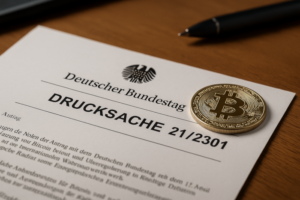


Greens call for abolition of the holding period for cryptocurrencies
Greens present legislative proposal on crypto tax
The debate on the tax treatment of Bitcoin and cryptocurrencies continues to gather pace.
Following statements by Federal Finance Minister Lars Klingbeil, the parliamentary group of Bündnis 90/Die Grünen has now also presented a concrete draft bill to abolish the current holding period for cryptocurrencies.
The proposal provides for profits from the sale of crypto assets to remain permanently taxable in future – regardless of how long Bitcoin or other cryptocurrencies have been held.
This would remove one of the central tax bases for long-term Bitcoin savings in Germany.
What does the holding period actually mean?
Currently applies in Germany:
Anyone who buys Bitcoin or other cryptocurrencies privately and holds them for longer than a year can realize potential gains tax-free.
Profits must be taxed within this so-called speculation period.
However, this principle does not only apply to cryptocurrencies, but also to other private sales transactions – for example in the case of:
- Gold
- silver
- Foreign currencies
- Works of art
- historical collector’s items
The Greens now want to abolish this regulation exclusively for cryptocurrencies.
How should cryptocurrencies be taxed in future?
An important point of the draft law:
The Greens do not propose taxation via capital gains tax or flat-rate withholding tax.
Instead, cryptocurrencies should continue to fall under the rules for so-called private sales transactions (Section 23 EStG) – but without a holding period.
In concrete terms, this means
Today:
- Sale within one year → taxable at personal income tax rate
- Sale after more than one year → tax-free
Green proposal:
- Every sale remains taxable
- regardless of the holding period
- Taxation at the personal income tax rate
The draft bill explicitly states:
“This means that income from the private sale of crypto assets is taxed at the personal income tax rate regardless of the duration of the holding.”
This would have a significant impact.
While share profits are taxed at a flat rate of 25% withholding tax, significantly higher tax rates could apply to cryptocurrencies in future, depending on income:
- 30 %
- 35 %
- 42 %
- or up to 45% income tax
plus solidarity surcharge and, if applicable, church tax.
How do the Greens justify their proposal?
In the draft bill, the Greens speak of a “fairness gap” in German tax law.
One of the reasons for this is that:
- Share profits are permanently taxable
- Cryptocurrencies are increasingly being used speculatively
- Germany has comparatively attractive tax regulations within Europe
- and the abolition of the holding period could generate additional tax revenue
The group anticipates additional revenue of around 5 billion euros.
Critical classification of the proposal
The discussion about tax rules is legitimate. This is precisely why an objective and fact-based debate is needed.
However, the current proposal raises considerable questions.
1. questionable assumptions regarding expected tax revenues
The billions mentioned in the draft bill are based on forecasts whose reliability is disputed.
Crypto markets are subject to strong cycles. Tax revenue from price gains can therefore not be extrapolated on a permanent or linear basis.
Anyone pricing potential income from boom phases into long-term budget plans is taking considerable fiscal risks.
2. risk of special tax treatment
The fact that the holding period is to be dropped exclusively for cryptocurrencies is viewed particularly critically.
This is because tax law has so far treated Bitcoin and other crypto assets as other “economic assets” within the meaning of Section 23 of the German Income Tax Act (EStG) – comparable to gold or foreign currencies.
An isolated special regulation only for cryptocurrencies could therefore raise questions regarding the principle of equal tax treatment.
What’s more, although
The Greens argue that crypto would be treated equally to shares, it would actually be treated worse than shares in terms of tax.
Because:
- Shares → flat-rate 25% withholding tax
- Cryptocurrencies → progressive income tax rate of up to 45 %
3. international competitiveness is ignored
The draft law argues that Germany is an exception within Europe with its current regulations.
However, there are also comparatively attractive regulations in other European countries:
- Portugal also has tax holding periods
- Croatia works with longer deadlines
- Czech Republic plans multi-year models
- Belgium, Luxembourg and Malta are still considered crypto-friendly
International competition for capital, innovation and companies has long been taking place.
4. effects on investors and companies
The current debate is already causing considerable uncertainty.
Not only private investors would be affected, but also, among others:
- Crypto exchanges and brokers
- Banks and financial service providers
- Tax consultants and compliance departments
- Bitcoin-related companies
- Payment providers and merchants
This is because a permanent tax liability would massively increase tax complexity in everyday life.
No “tax loophole”, but existing system
In the public debate, there is often talk of a “tax gap”.
In fact, cryptocurrencies are already subject to taxation today – namely within the existing speculation period.
The current regulation is therefore not an exception specifically for Bitcoin, but part of a tax system for private sales transactions that has existed for decades.
The Greens’ bill shows one thing above all:
The political discussion about abolishing the holding period is real.
Even if nothing has been decided yet, it is clear that political forces are already positioning themselves in favor of stricter taxation of cryptocurrencies.