
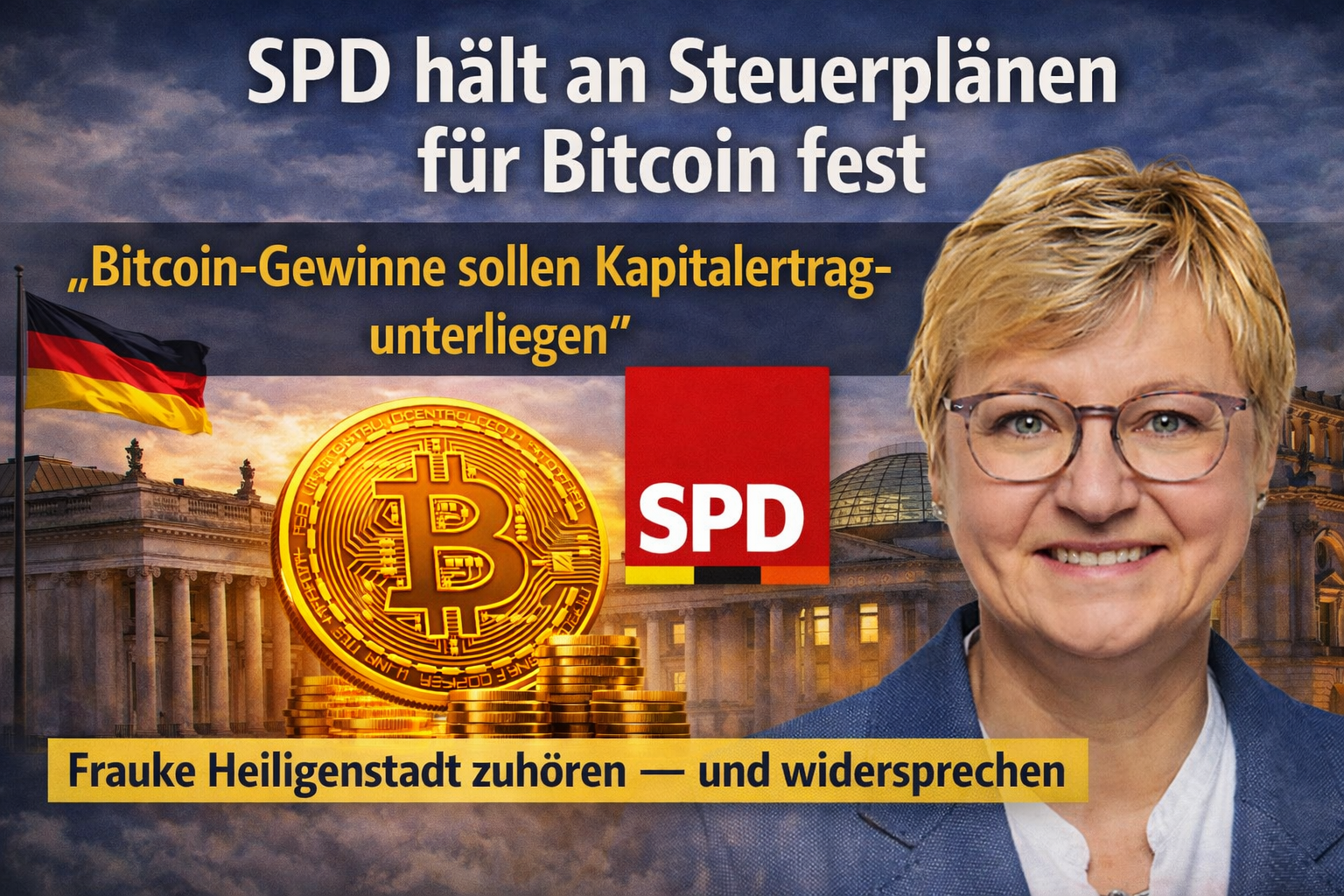
SPD sticks to tax plans for Bitcoin
SPD sticks to tax plans for Bitcoin. Frauke Heiligenstadt (SPD) says: Bitcoin profits should be subject to capital gains tax.
The debate about the tax treatment of Bitcoin and other crypto assets in Germany remains politically topical. The reason for this is a new report by BTC-ECHO, in which the financial policy spokesperson for the SPD parliamentary group in the Bundestag, Frauke Heiligenstadt, reaffirms her party’s position: Profits from the sale of crypto assets should be subject to capital gains tax in future. At the same time, the article makes it clear that the recent rumors about a political deal to abolish the one-year holding period are not true.
This makes the situation clearer, but no less harmless. The SPD is continuing to pursue the issue strategically. According to BTC-ECHO, Frauke Heiligenstadt justifies her party’s position with equal taxation, tax justice and transparency. From the SPD’s point of view, crypto profits should be treated similarly to other capital income; she also refers to possible advantages such as loss offsetting. Politically, this is a coherent argument. On the substance, however, it remains vulnerable.
Firstly, this would not be a mere clarification, but a genuine system change. According to current German administrative practice, private gains from the sale of crypto assets are generally treated as private sales transactions. The Federal Ministry of Finance has reconfirmed this basic line in the revised BMF circular dated March 6, 2025. The SPD therefore wants to move away from the previous § 23 logic with a holding period and towards taxation as for capital income.
Secondly, the argument of equal treatment to interest and dividends is only convincing to a limited extent. In economic terms, Bitcoin is not an interest-bearing claim and not a dividend-paying investment. There is no issuer, no ongoing cash flow and regularly no classic income component. The formula of “equal taxation” is therefore primarily a political argument of order – not a compelling logical consequence of the nature of Bitcoin.
Thirdly, the SPD’s argument of loss offsetting is also not a sure-fire success. A new regime could bring advantages for individual investors, but at the same time create new transitional problems. Tax practitioners point out, for example, that old losses from the previous system could not easily be offset against gains in a new capital income regime. The SPD therefore mentions possible advantages, but largely ignores the practical disruptions of a change of system.
The most important finding from the BTC-ECHO report is therefore: the immediate panic was exaggerated, but the political danger was not. There is currently no documented evidence of a deal already in place to quickly abolish the holding period. At the same time, Frauke Heiligenstadt’s statement shows that the SPD is pursuing this goal politically. Earlier SPD papers and reports on the coalition negotiations already made it clear that the party wants to tax crypto profits like capital income in future.
From the perspective of the Bitcoin Bundesverband, it is therefore important to make an objective classification. Anyone who prematurely categorizes Bitcoin in a tax scheme for traditional capital investments is underestimating its economic nature and the consequences for long-term wealth creation, innovation and attractiveness as a business location. The debate has not been decided – but it is politically real.
Source: BTC-ECHO, “SPD pushes for Bitcoin tax reform: ‘Profits should be subject to capital gains tax‘”, 20.03.2026.