


Bitcoin taxes:
Don’t repeat Austria’s mistake
Eric Demuth from Bitpanda sounds the alarm
Bitcoin taxes: Don’t repeat Austria’s mistake. Eric Demuth from Bitpanda sounds the alarm
The debate about the possible abolition of the one-year holding period for Bitcoin and other crypto assets in Germany continues to gain momentum. While additional tax revenues, alleged “crypto gaps” and new burdens for investors are being discussed in Berlin, a clear warning is coming from Austria.
The holding period has already been abolished there. And Eric Demuth, co-founder of Bitpanda, of all people, is now explicitly warning against repeating this approach in Germany.
Looking to Austria is important
Austria has fundamentally changed its taxation of crypto assets with effect from March 1, 2022. Since then, cryptocurrencies have generally been treated as capital assets for tax purposes. A special tax rate of 27.5 percent applies to “new holdings”, i.e. crypto assets acquired after February 28, 2021. The Austrian Ministry of Finance explicitly states this.
What sounds like simplification and equal treatment with other asset classes on paper has apparently produced considerable side effects in practice. This is precisely what Eric Demuth is now pointing out.
Eric Demuth’s warning is clear
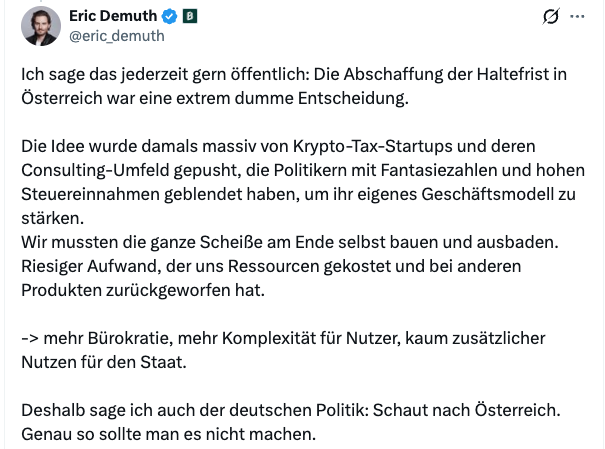
In the current discussion on X, Demuth contradicted the claim that Bitpanda itself actively worked towards the abolition of the holding period in Austria. Instead, he writes that the opposite was the case: It had lobbied against this change. He literally describes the abolition of the holding period in Austria as “an extremely stupid decision”.
His reasoning is particularly clear: The change had presented Bitpanda with massive operational problems. The company had to invest considerable resources to implement a complex system for tax processing. This project had set the company back significantly in other projects. According to Demuth, the reform primarily resulted in more bureaucracy, more complexity for users and hardly any additional benefit for the state.
His political message to Germany is therefore clear: Germany should not make the same mistake as Austria.
This warning deserves attention. Not just because it comes from the industry, but because it comes from an entrepreneur whose company has had to implement the practical consequences of such a model itself.
What Austria teaches Germany
The discussion in Germany is often conducted as if the abolition of the holding period is a simple tax policy lever: a few legal adjustments, more fairness, more revenue. However, a look at Austria shows that the reality is more complicated.
Putting Bitcoin on an equal footing with traditional investments for tax purposes may sound politically attractive to some. In practice, however, it entails complex consequential problems:
-
higher technical and regulatory requirements for exchanges and brokers,
-
more documentation and verification obligations,
-
more uncertainty and complexity for users,
-
additional effort for product development, reporting and processing.
Bitpanda itself now provides its own information on the Austrian withholding tax on crypto assets and describes in detail when an automatic tax deduction applies for Austrian customers. This alone makes it clear how far-reaching the consequences of the reform are in practice.
So when a market participant who had to implement these rules technically and operationally today warns against transferring the model to Germany, this experience should be taken seriously in the political debate.
Germany is currently discussing the wrong direction
In Germany, the situation is currently still different. Under current law, gains from private sales transactions involving crypto assets are generally tax-free if there is more than one year between acquisition and sale. The Federal Ministry of Finance has also confirmed this basic line in its letter on individual questions regarding the income tax treatment of crypto assets.
At the same time, there is growing political pressure to abolish this holding period. The current debate surrounding the so-called “crypto gap” is making an important contribution to this. In the ZeVeDi article by Co-Pierre Georg from March 10, 2026, the German holding period is described as “Germany’s most superfluous tax gift”; it mentions up to 11.4 billion euros in potential additional tax revenue.
(See also: The 11.4 billion euro question)
This debate has now had a political impact. However, it is worth taking a critical look at Austria: high fiscal expectations and supposedly simple solutions can quickly lead to more complexity, more bureaucracy and considerable false incentives in practice.
When even Bitpanda warns, Berlin should listen
It is particularly noteworthy that the warning does not come from a purely ideological corner, but from one of Europe’s best-known crypto entrepreneurs. Bitpanda is not a fundamentalist outsider, but a regulated market participant with direct experience in a country that has already abolished the holding period.
This is precisely why Demuth’s statement is so politically relevant. His message is not that tax rules for crypto assets are fundamentally impossible. Rather, his message is that the abolition of the holding period in Austria was a mistake that resulted in high operating costs, more complexity and little real added value.
Germany should learn from this instead of repeating the same wrong decision with a delay.
The false incentives of such a reform
Abolishing the holding period would not only affect investors. It would also change the character of Germany as a Bitcoin location.
The current regulation provides an incentive for long-term thinking, personal responsibility and sustainable holding. A permanent taxation of capital gains, on the other hand, would increase complexity and keep many users even more in tax and technically mediated platform structures. That would not be progress, but a step backwards.
What’s more: In Austria, various providers are now actively campaigning to make the tax complexity there manageable for users. Blockpit describes the Austrian reform today as an existing regime under which crypto assets for new holdings are taxed at 27.5% and international reporting obligations are further expanded.
This is precisely where a fundamental problem lies: the more complicated tax law becomes, the more those who profit from this complexity with software, consulting and reporting will inevitably benefit. This is not an advantage for users, innovation and location quality.
German legislators should not be blinded by model calculations
In Germany, the debate is currently dominated by large tax figures. Such model calculations may be politically attractive. However, they do not replace the question of what consequences a reform would have in reality.
Austria provides a cautionary example of this. It shows that a supposedly modern and fair reform can lead to more operational effort, higher adjustment costs and greater complexity in practice. When an entrepreneur like Eric Demuth, of all people, who has experienced the practical consequences first-hand, warns against a repetition of this path in Germany, this should not be ignored in Berlin.
Conclusion
Germany is at a crossroads in terms of tax policy. At first glance, the abolition of the holding period for Bitcoin and other crypto assets may seem like a simple lever for more tax revenue. However, a look at Austria shows that the reality can be different.
More bureaucracy, more complexity, considerable operational burdens and hardly any convincing additional benefits for the state – this is exactly how Eric Demuth describes the Austrian experience today.
The Bitcoin Bundesverband therefore believes that this warning should be taken seriously. Anyone deciding on the future of Bitcoin taxation in Germany should not only look at political slogans and model calculations, but also at practical experience from countries that have already gone down this path.
Germany must not repeat Austria’s mistake with Bitcoin taxes.
Related article at Blocktrainer: “Bitpanda founder warns Germany against abolishing the crypto holding period”