
The 11.4 billion euro question
Why the current debate on the crypto holding period needs more transparency
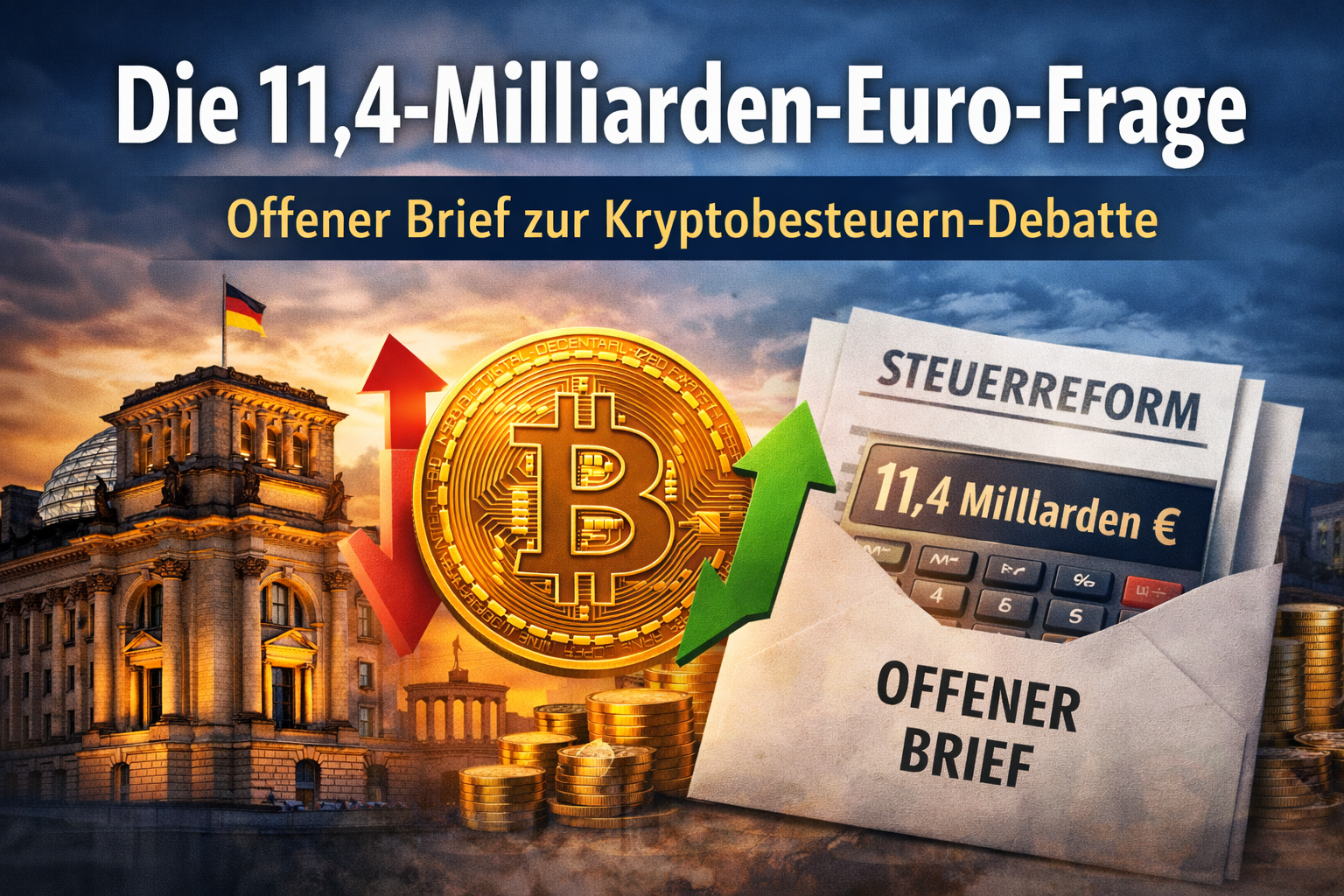
In the current debate on the taxation of Bitcoin and other crypto assets in Germany, one figure keeps cropping up: 11.4 billion euros. This sum is cited as a possible additional tax revenue that could be generated by reforming German crypto taxation. The figure is politically explosive. It is taken up in public debate, quoted in the media and obviously serves as an argument for fundamentally questioning the one-year holding period for private crypto profits in Germany.
The figure comes from an article by Co-Pierre Georg, published on 10 March 2026 in the eFin blog of the Centre for Responsible Digitalization (ZeVeDi). It states that almost two thirds of all private crypto profits in Germany would remain tax-free and that four reform models could generate additional revenue of up to 11.4 billion euros for 2024 alone. At the same time, the German holding period is explicitly described as “Germany’s most superfluous tax gift”. The text is therefore not only a descriptive analysis, but also a clearly positioned political contribution to the debate.
Co-Pierre Georg is Professor of Practice in Digital Finance and Technology at the Frankfurt School of Finance & Management and Director of the Frankfurt School Blockchain Center. His voice therefore carries weight – both in professional circles and in political discussions. This is precisely why it is important to carefully examine the viability of the underlying data, assumptions and projections.
The ZeVeDi article is based on so-called “industry data”. At the same time, Blockpit advertises its “Crypto Tax Study 2025 Germany” with, among other things, exactly the same key figures that keep cropping up in the debate: 47.3 billion euros in realized profits, over 63% tax-free, a median portfolio of 13,000 euros and other extrapolated statements about the behaviour of German crypto users. This suggests that Blockpit data plays a central role in the public debate.
This makes the question of methodological robustness all the more important. After all, there is a considerable difference between an eye-catching figure and a sound basis for legislation. A political debate on tax law should not be based solely on catchy projections, but on comprehensible methodology, transparent assumptions and reliable statements on representativeness, data quality and uncertainties. This is all the more important when a model calculation is almost perceived by the public as a fixed fiscal policy lever.
In addition, the DAC-8 Implementation Act and the Crypto Asset Tax Transparency Act have already created a reporting and transparency framework for crypto assets in Germany. This serves to exchange information on transactions, but does not automatically create new tax situations. This is another reason why it is problematic if the combination of transparency rules and model calculations gives the impression that a certain tax policy conclusion is already mandatory or scientifically proven.
The Bitcoin Bundesverband considers it legitimate to discuss tax policy rules. It is equally legitimate to defend the current holding period or to call for its reform. However, it would not be legitimate to base such a far-reaching political decision on data and assumptions whose validity has so far only been comprehensible to outsiders to a limited extent. Anyone who wants to abolish the holding period or reorganize the tax regime for Bitcoin and other crypto assets should be able to demonstrate the empirical basis on which this is being done – and how reliable this basis actually is.
The Bitcoin Bundesverband therefore seeks dialog with politicians, academics and market participants. We endeavor to remain in contact with politicians from all democratic parties and to provide factual information about Bitcoin. This also includes asking questions publicly when key figures in an ongoing political debate require further explanation.
Open letter on the methodology of the current crypto tax debate
To Blockpit and Mr. Florian Wimmer
and to Professor Co-Pierre Georg
Dear Mr. Wimmer,
Dear Professor Georg,
Ladies and Gentlemen,
The current debate on the taxation of Bitcoin and other crypto assets in Germany is currently dominated by the figure of potential additional tax revenue of up to 11.4 billion euros. This figure is being picked up intensively by the media, the public and politicians and is clearly influencing the tax policy debate on the future of the one-year holding period for private crypto profits in Germany.
Against this background, we consider it important to classify the data basis, the methodology and the scope of these statements in a transparent and comprehensible manner.
Professor Georg’s article in the eFin blog of the Centre for Responsible Digitalization from 10 March 2026 describes four reform models for closing the so-called “crypto gap” and mentions additional revenue of up to 11.4 billion euros for 2024 alone. Blockpit is publishing its own key figures on the “Crypto Tax Study 2025 Germany” in parallel, which obviously play a central role in this debate.
Precisely because these figures now have a political impact far beyond the circle of professionally interested observers, we request a more detailed methodological classification and – as far as possible – additional transparency regarding the underlying data and assumptions.
We therefore request information on the following points:
1. sample size and selection
How many user accounts or data records were included in the underlying evaluation? What criteria were used to select or consider these data records?
2. relation to Germany and tax residency
How was it ensured or at least made plausible that the users included were actually subject to German tax law in the relevant period?
3. data quality
What quality criteria did data sets have to fulfill in order to be included in the analysis? Were data records with recognizable inconsistencies, gaps or warnings excluded?
4. completeness of the data records
How was it ensured that only sufficiently complete data sets were used, i.e. in particular that all relevant wallets, exchanges, CSV uploads and other integrations were included?
5. duplicates and multiple entries
What measures have been taken to avoid double counting, for example through multiple accounts, test accounts, training access or redundant data imports?
6. definition of the key figures used
How exactly were terms such as “realized gains”, “tax-free gains” and “taxable gains” defined? Were only capital gains considered or were other tax-relevant facts also included?
7. extrapolation to the German market as a whole
What methodology is used to extrapolate the analyzed user data to the German market as a whole? What assumptions were made?
8. uncertainties and bandwidths
What statistical uncertainties exist in the extrapolation? Are there margins of error, confidence intervals, sensitivity analyses or alternative scenarios?
9. distribution of profits
Can you provide a more detailed breakdown of the distribution of tax-free and taxable profits, for example by size category? For the political classification, it would be particularly relevant to know whether a large part of the determined volumes is borne by a few very large cases or by a broad mass of smaller cases.
10. time of the data cut
When exactly was the data cut for the analysis?
11 External validation
Has the methodology or the result been validated by third parties, such as tax experts, statisticians or scientific partners?
12. access to the methodology
Is there more detailed methodological documentation that clearly shows the data basis, adjustment steps, assumptions and extrapolation procedures?
13. role of the blockpit data in the ZeVeDi analysis
Addressed to Professor Georg: On what specific data basis are the reform models presented in the ZeVeDi article based? Was there access to raw data, to aggregated key figures or to otherwise prepared data sets?
14 Scientific classification
Is the ZeVeDi contribution a scientific study in the narrower sense, a policy paper or a journalistic contribution to the debate? Are there any supplementary documents, calculation appendices or more detailed methodological documentation?
15. behavioral assumptions in the reform models
Which behavioral adjustments of investors were assumed in the four reform models, in particular with regard to investment decline, evasive reactions, holding behavior and tax compliance?
Our concern is expressly not a blanket delegitimization of the published figures. On the contrary: an open and transparent answer to these questions could help to objectify the ongoing debate and make the empirical basis of the political discussion more comprehensible.
Particularly when it comes to tax policy decisions with significant consequences for citizens, companies and Germany as a location for innovation, the following should apply: The greater the political impact of a figure, the higher the demand for transparency, comprehensibility and methodological resilience.
The Bitcoin Bundesverband will continue its efforts to remain in contact with politicians from all democratic parties as well as with academics and market participants and to provide factual information about Bitcoin. This also includes critically questioning methodological principles where they are used to justify far-reaching political interventions.
We would appreciate a public or direct response.
Yours sincerely
Bitcoin Federal Association