
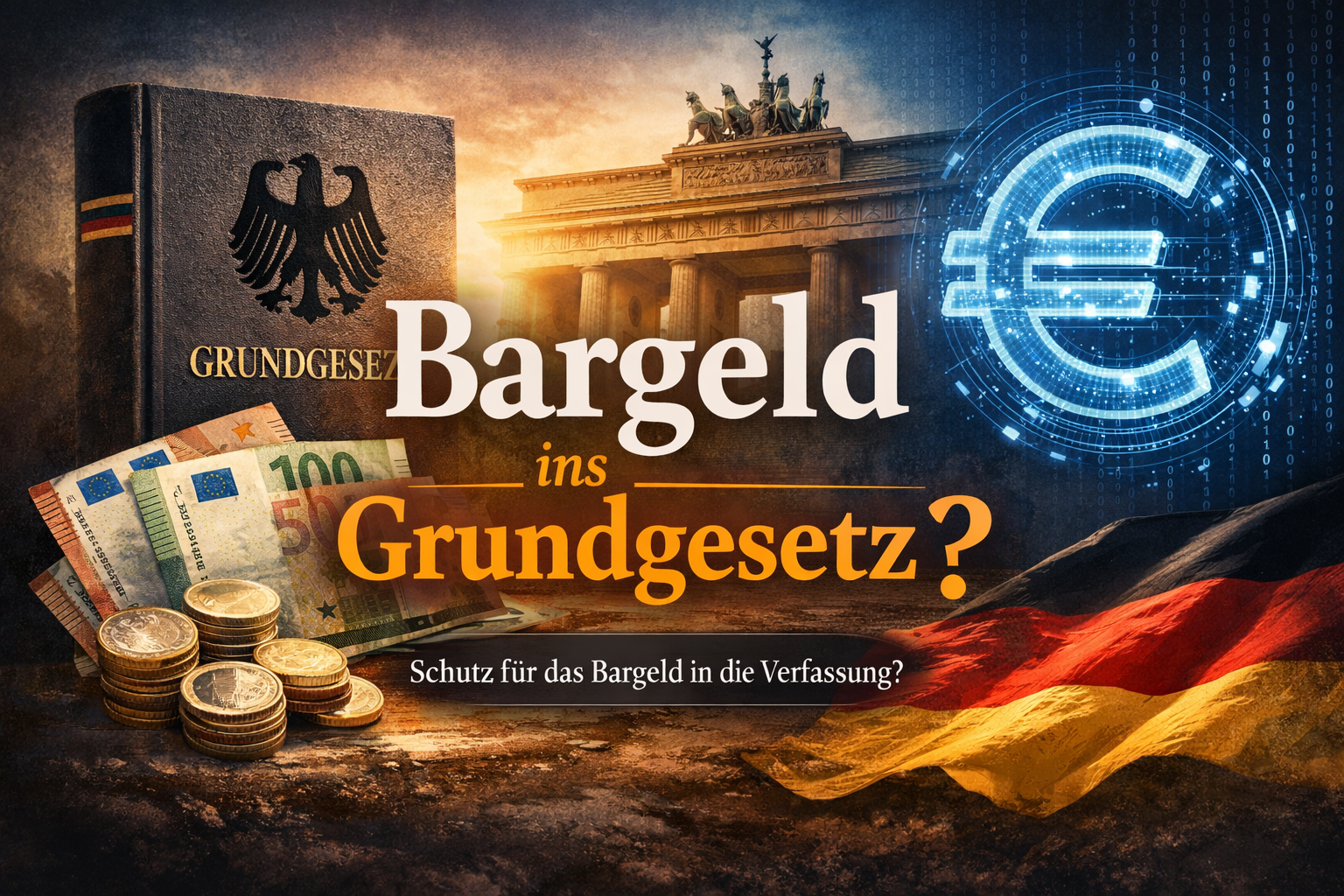
Cash in the constitution
Should cash be enshrined in Germany’s Basic Law?
In Switzerland, a clear majority of voters voted on March 8, 2026 to secure the supply of cash and the protection of the national currency at constitutional level. According to official information from the Swiss authorities, the supply of cash was thus expressly enshrined as a state task. heise also reported on the 73.4 percent approval.
The obvious question is: should Germany be having a similar debate?
Not as a party political demand. Not as an official concern of the Bitcoin Bundesverband. But as a serious consideration at a time when our monetary system is visibly changing.
Cash is more than just a means of payment
For many people in Germany, cash is much more than just a practical tool at the checkout. It stands for immediate availability, independence from technology, crisis resistance and, above all, a bit of privacy.
People who pay with cash leave far fewer data traces in their everyday lives than with digital payment methods. This is precisely where many citizens see real value: not every payment should be permanently traceable, analyzable or profilable.
This attitude is by no means backward-looking. It is an expression of a legitimate need for self-determination in everyday life.
Why the debate is relevant right now
The background is obvious: with the digital euro, the Eurosystem is working on a new form of digital central bank money. The ECB expressly emphasizes that the digital euro is intended to supplement cash and not replace it. It also refers to high data protection standards and a planned offline function that is intended to provide a level of privacy similar to cash.
Nevertheless, the skepticism remains understandable.
After all, what is described today as a supplement may be given a different political and regulatory weighting over the years. If digital payment increasingly becomes the norm, if acceptance obligations for electronic means of payment are extended and if cash use continues to decline in everyday life, at some point the question will no longer be just a technical one, but a fundamental one: how robust is the protection of cash really?
The Bundesbank itself points out that a decline in the use of cash can develop into a self-reinforcing process, at the end of which availability and acceptance would be significantly reduced. At the same time, it emphasizes that the supply of cash in Germany is part of its legal mandate.
Is the current protection sufficient?
In Germany, there are already constitutional and simple legal points of reference relating to cash. Article 88 of the Basic Law regulates the currency and central bank regulations. Scientific services of the Bundestag also point out that the use of cash is also linked to informational self-determination and general freedom of action.
But this is precisely the difference to the Swiss decision:
There, cash is not only indirectly protected, but is explicitly and unmistakably elevated to constitutional status. This is not just symbolism. It is also a signal: physical money is still wanted.
The real question for Germany is therefore not just whether cash is still permitted today. The more crucial question is: should its permanent availability and usability be explicitly safeguarded?
Cash as a freedom and resilience infrastructure
Anchoring it in the Basic Law would not be an anti-technology step. Nor would it have to be a vote against digital innovation. On the contrary, it could be seen as a constitutional safeguard for freedom of choice.
After all, a modern society should enable both:
digital payments where they make sense and are desired,
and cash where people want to pay directly, anonymously and without technical dependency.
Especially in crises, power outages, system disruptions or the failure of payment infrastructure, it becomes clear that cash is more than just nostalgia. It is an analog safety net.
The view from a Bitcoin perspective
For the Bitcoin Bundesverband, the debate is also interesting because it touches on a central point: Money is always also a question of freedom, access and privacy.
The critical view of the digital euro does not mean that digitalization should be rejected in principle. On the contrary: open, freely usable digital payment systems are important. However, the decisive factor is how they are designed.
From a BTCBV perspective, digital payment solutions that are based on openness, interoperability and a high degree of user autonomy deserve particular attention. Reference is often made here to Bitcoin and Lightning in particular, because they enable digital payments without central government control.
This does not mean that cash and Bitcoin are opposites. In some ways, they are even on the same side of a larger debate: the debate about free choice, decentralization and privacy in the monetary system.
Not a demand, but a legitimate question
This article is not a demand by the Bitcoin Bundesverband to include cash in the German constitution. Rather, it is intended to initiate a discussion.
The Swiss decision shows that cash does not simply have to be an obsolete model that is tacitly left to technological change. A society can also make a conscious decision to explicitly protect physical money as part of its liberal order.
Perhaps it is also time to ask this question openly in Germany:
If cash stands for freedom, privacy, resilience and choice, shouldn’t its protection be more strongly and visibly secured under constitutional law?